info@airmep.in | +91-9810220896 | New Delhi, Delhi, 110015

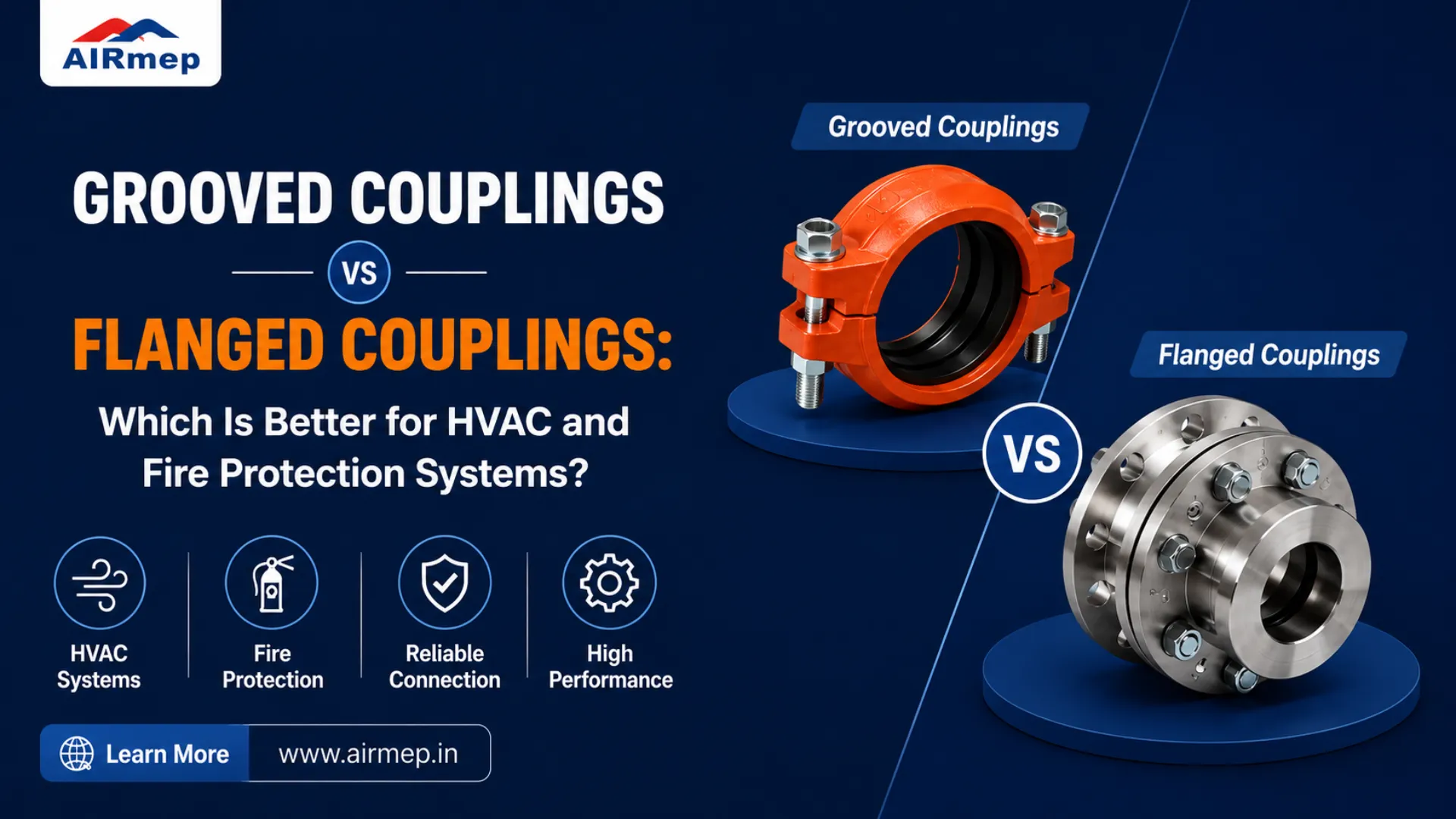
Grooved Couplings vs Flanged Couplings: Which Is Better for HVAC and Fire Protection Systems?

Generally, between the comparison of grooved couplings vs flanged couplings, the former is considered better. These are superior choices for HVAC and fire protection systems because of their faster installation speed, lower labor costs, and vibration absorption ability. However, flanged connections are best for joining pipes directly to heavy equipment pumps and chillers.
Choosing the right way to connect your pipes is very important. The two popular ways to join them are grooved and flanged couplings. Between the comparison of grooved couplings vs flanged couplings, the grooved ones are preferred as they use clamps and rubber seals to lock pipes fast. However, flanged couplings use heavy bolts, create strong joints, and handle high pressure well. This means both these options are great and have their own special advantages. Read on to know the key differences between them so that you can know which works best for your project.
Table of Contents
What Are Grooved Couplings: Key Advantages and Disadvantages
Grooved couplings are used to join two pipes together without welding, threading, or soldering. These use a rubber ring to create a leakproof seal and strong metal clamps that grip grooves cut into the pipe ends. Even with simple bolts and nuts, they lock tightly together. They are not just faster to install but also very easy to fix and great for small spaces.
Key Advantages of Grooved Couplings
- Fast Setup: The main difference between grooved and flanged couplings is that the former ones are 3 to 5 times faster to install and save a lot of work time.
- Safer Work: No welding or threading is needed to join the pipes using them. As no open flames or toxic fumes are produced, they are much safer.
- Easy Fixes: Another great advantage of flexible grooved couplings for HVAC systems and fire protection systems is that they are easy to take apart. This makes cleaning and repairing pipes easy.
- Absorbs Movement: These bend slightly, and this feature helps them absorb vibrations and survive earthquake impacts.
- No Leaks: The rubber gasket in these couplings locks tighter as pressure inside the pipe builds.
Key Disadvantages of Grooved Couplings
- Costly Parts: These couplings have special rubber gaskets and metal parts that make them more costly.
- Need Good Pipes: The pipes must be perfectly round and cut correctly. If the pipe is bent or uneven, the joint will leak.
- Temperature Limits: One major disadvantage of grooved couplings for fire protection systems is that their rubber gasket can melt or get damaged in very high temperatures.
- Special Tools: You need special tools to cut the exact grooves into the pipe ends before you can use these couplings.
Grooved Fittings Working Mechanism
Grooved couplings, especially flexible couplings, are preferred for fire sprinkler networks and fire protection piping systems. The best part about them is that they safely handle earthquakes, structural shifts, and temperature changes without leaking.
Step 1: Pipe End Preparation
Firstly, you need to roll or cut a mechanical groove into the exterior surface near the pipe end, so it can be joined without welding or threading.
Step 2: Gasket Alignment
The strong rubber gasket bridges the gap between the two pipe ends to create a pressure-responsive, primary fluid seal.
Step 3: Housing Engagement
Next, you need to position the heavy-ductile iron housing sections around the gasket. You must make sure the raised edges fit perfectly into the cuts in the pipe.
Step 4: Mechanical Locking
Lastly, tighten the bolts physically to secure the housing in place. This creates a strong mechanical joint.
What Are Flanged Couplings: Key Advantages and Disadvantages
Before discussing the difference between grooved and flanged couplings, let’s understand what flanged couplings are. These are simple pipe joints that are made by connecting two heavy metal rings. The rings are attached to the pipe ends. You need to place a flat seal between them and screw them tightly using heavy bolts. This creates a strong, leak-proof joint that is capable of handling high water pressure in large pipelines.
Key Advantages of Flanged Couplings
- High Pressure Resistance: These are very strong, which makes them perfect for hot pipes and those handling extreme pressure.
- Superb Rigidity: Flanged couplings hold long and heavy pipelines completely straight without bending.
- Excellent Sealing: They feature tight bolting that stops all leaking issues from occurring in critical and high-risk systems.
- Large Diameter Support: These pipe joints are perfect and fit well on very wide industrial and large-scale water lines.
- Temperature Tolerance and Design: A major advantage of these couplings is that they handle high heat easily and match globally using engineering dimensions.
Key Disadvantages of Flanged Couplings
- Very Heavy: They are heavy and big; their massive weights and size add extra stress to the entire pipeline. So, they are not ideal for tight structural areas. support.
- Slow Installation: In a comparison of grooved vs flanged piping systems, the installation speed of flanged couplings is slow, as it requires connecting dozens of bolts.
- High Labor Cost: Highly skilled workers are required to ensure everything aligns perfectly. This makes its installation more expensive.
- Requires Frequent Maintenance: They don’t bend or absorb pipe vibrations, so their bolts loosen over time. So, you need to constantly check and retighten them to prevent leaks.
Flanged Connections Working Mechanism
Flanged connections are a mechanical way to join two pipes, valves, or parts of equipment together. This tough setup safely handles the intense water pressure near the main pumps and the base of fire protection piping systems.
Step 1: Flange Attachment
To permanently attach a large metal ring (flange) to a pipe, you can either weld it on heavily or screw it on tightly with deep threads.
Step 2: Gasket Insertion
Next, you need to place a flat, heavy-duty sealing ring (gasket) exactly in the middle between the faces of the two opposing flanges.
Step 3: Hole Realignment
Now, you have to rotate the pipes so that bolt flanges on both metal rings match up perfectly to ensure even pressure distribution.
Step 4: Insert and Tighten the Bolts
Insert the heavy-duty bolts through the aligned holes. Make sure you tighten them in a crisscross or start pattern to keep the pressure balanced.
Step 5: Lock It Tight
Keep tightening the bolts equally until the seal is completely flat and locked in place. This eliminates all potential leak paths.
Grooved Couplings vs Flanged Couplings: Key Differences
Understanding the comparison of grooved couplings vs flanged couplings will help you choose the best joint for your piping system. Each method has different advantages, so the perfect option depends on your specific project needs.
| Factor | Grooved Couplings | Flanged Couplings |
| Maintenance | Easy to maintain. Only two bolts need to be loosened for access. | More time-consuming. Requires removing multiple bolts and careful reassembly. |
| Fire Hazard Risk | Flameless installation with no welding required, making it safer. | Often requires welding, creating heat, sparks, and fire risks. |
| System Flexibility | Available in flexible and rigid designs. Can absorb vibration, thermal expansion, and minor movement. | Completely rigid connection with little to no flexibility. |
| Durability | Durable and long-lasting, suitable for most applications. | Highly durable and a better choice for high-pressure and heavy industrial environments. |
| Alignment & Sealing | The rubber gasket provides reliable sealing with less alignment effort. | Requires precise alignment to achieve a proper seal. |
| Upfront Cost | Generally, lower material and installation costs. | Usually higher initial cost, but can be economical for high-pressure systems. |
| Installation Speed | Quick installation using a clamp and two bolts. Can be installed 6 to 10 times faster. | Slower installation due to multiple bolt holes that require precise alignment. |
| Best Use Case | Fire protection, HVAC, commercial buildings, and projects requiring fast installation. | Heavy industrial systems, high-pressure pipelines, and demanding applications. |
- Installation and Speed: Grooved couplings are very fast to assemble because they use a simple clam and bolt design. This simply means they don’t require welding and can be installed 6 to 10 times faster than heavy flanged connections. Flanged joints require aligning multiple holes, while grooved couplings install fastest because workers simply tighten two bolts.
- Maintenance Needs/Ease: In comparison of grooved vs flanged piping systems, grooved joints are highly maintenance-friendly. You simply need to loosen two bolts and slide off the coupling housings. However, flanged systems require removing many bolts, which makes their maintenance time-consuming. Moreover, they require special star-pattern tightening when putting them back together.
- Fire Hazard Risk: The use of grooved couplings for fire protection systems is preferred because they are completely flameless. They don’t need on-site welding, so they have almost zero fire hazard risk. However, flanged joints require welding that creates intense heat, open flames, and bright sparks. By using grooved couplings, you can eliminate all fire risks and make a safe choice for modifications in enclosed spaces or active buildings.
- System Flexibility: Grooved couplings can be flexible or rigid. Flexible grooved joints allow for a small amount of movement. They absorb equipment vibrations, pipe expansion caused by temperature changes, and minor misalignments. These joints safely accommodate building shifts during earthquakes. However, flanged joints form completely right connections that transfer structural stress, thermal expansion, and vibrations through the metal pipeline.
- Durability: Both these options are incredibly durable, and with proper maintenance, they even last more than 20 years. However, in the case of durability, which is better grooved coupling or flanged coupling, the latter one is more durable. Flanged joints are famous for their ability to handle extreme, heavy industrial pressure and severe physical stress. Grooved couplings are also tough, but they can struggle in systems with extremely high-pressure or heavy vibration.
- Alignment and Sealing: In grooved couplings, the rubber gasket ensures proper sealing without the need for exact bolt alignment. However, flange joints are harder to align perfectly. They often require a careful twisting, and you only know if the seal works after turning the water pressure on.
- Upfront Part Cost: Grooved couplings are generally cheaper than flanged options due to lower weight and fewer materials. When you consider the total cost, grooved systems help you save money in labor, but high-grade flanged fittings are more cost-effective for extreme pressures.
Grooved Couplings vs Flanged Couplings: Suitability
Grooved and flanged connections are used for similar purposes, but they excel in different conditions. Deciding which is better grooved coupling or flanged coupling, depends entirely on your project needs.
When to Use Grooved Couplings
- Installers prefer grooved couplings for HVAC systems because they handle pipe expansion and reduce operational noise.
- Professionals use grooved couplings for fire protection systems because they require minimal tools, making them smart fire safety solutions.
- They eliminate dangerous heat-based welding, making them the best choice for safe work zones in commercial and residential buildings.
When to Use Flanged Couplings
- They provide the strong and unmoving support required when bolting directly to heavy equipment, like large water pumps.
- They are especially designed to withstand severe physical stress over long periods in the most demanding industries, like oil and gas and power plants.
- They are perfect for highly pressurized piping networks that carry dangerous or very heavy industrial fluids, like chemical processing plants.
Upgrade Your Piping Systems with Airmep Sales Corp
The result of our discussion of the comparisons of grooved couplings vs flanged couplings is that the former is a better choice for modern HVAC and fire systems. The faster installation, maintenance ease, and vibration reduction make them ideal for them. However, the flanged joint offers reliable and rigid connections required for heavy equipment.
Upgrade your piping systems with certified piping solutions from Airmep Sales Corp. We are a trusted supplier of premium Victaulic pipe joining products. We deliver products designed to deliver faster installation and eliminate all leak problems. Connect with our experts to discuss your needs and get help in choosing the right solutions. Secure high-quality fire pipe couplings, fire sprinkler pipe couplings, and fitting solutions for your next project with Airmep.
Also Read:
- Rigid Coupling vs Flexible Coupling – Key Differences, Types, Applications & Benefits
- What is a Humidity Sensor? How They Work, Types, and Applications
Frequently Asked Questions (FAQs)
1. Which is better grooved couplings or flanged couplings?
Grooved couplings are generally better for HVAC and fire protection systems because of their faster installation and maintenance ease. Flanged couplings are best for high-pressure applications and heavy equipment connections.
2. Do grooved couplings require special tools for installation?
Pipe ends must be grooved using special equipment before the coupling can be installed. But their actual assembly process is very simple and quick.
3. Are flanged couplings more durable than grooved couplings?
Both options are highly durable and work effectively for decades with proper maintenance. However, flanged fire pipe couplings and fittings are more resistant to high pressure, temperature, and mechanical stress.
4. Which coupling type is easier to maintain?
Grooved couplings are easier to maintain because you only need to loosen a few bolts to access the pipe. However, flanged systems require removing and re-tightening multiple bolts during maintenance.
5. Can grooved couplings absorb vibration and thermal expansion?
Flexible grooved couplings absorb vibration, accommodate thermal expansion, and handle minor pipe movement. So, they are preferred to reduce stress on the piping system.