info@airmep.in | +91-9810220896 | New Delhi, Delhi, 110015

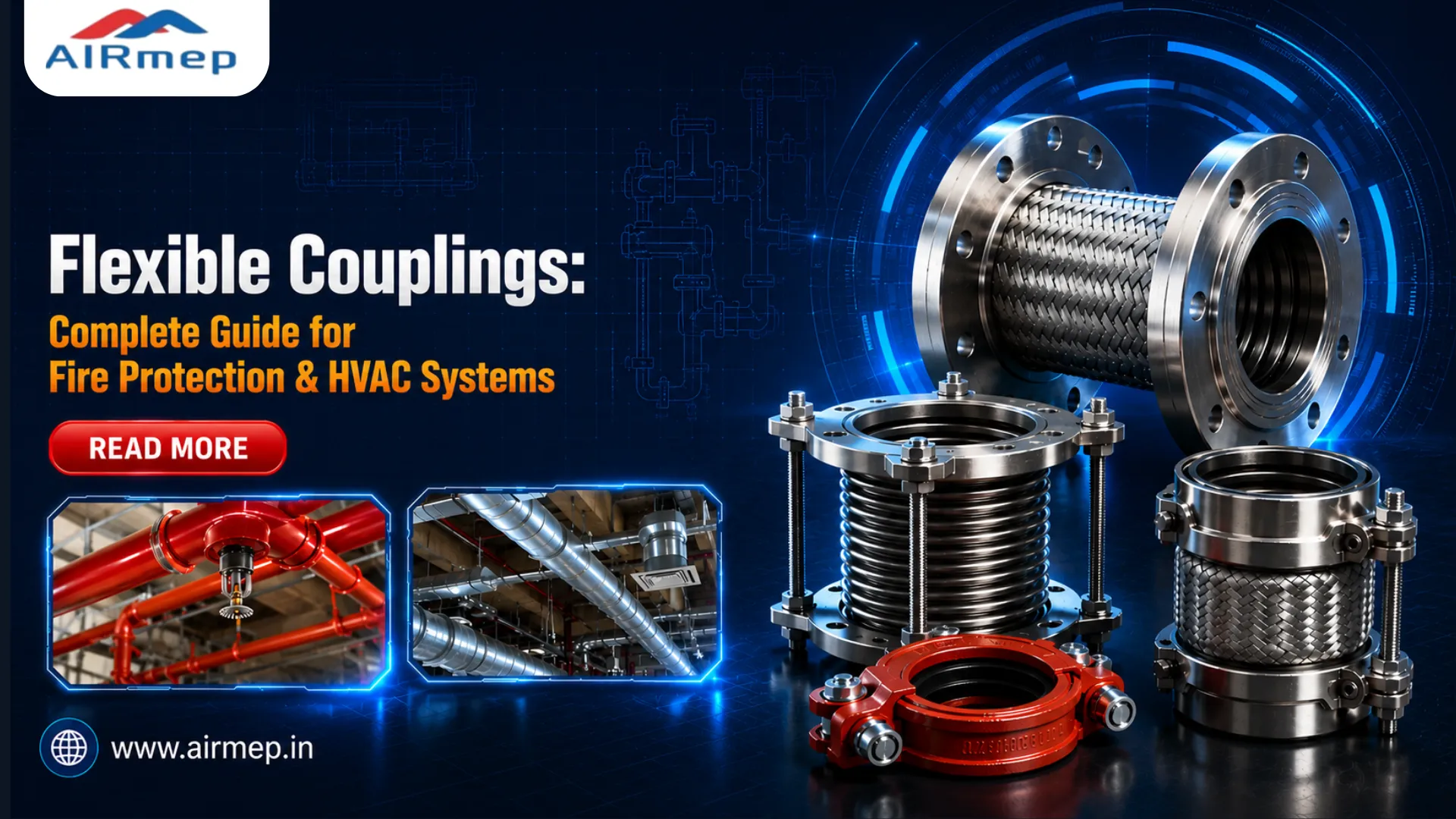
What Are Flexible Couplings? Complete Guide for Fire Protection & HVAC Systems

Flexible couplings are specialized mechanical pipe connectors developed to permit limited angular, linear, and rotational movement. In fire safety and HVAC systems, they absorb thermal growth, suppress noise and vibration, and secure tools from seismic activity or building settlement, making sure leak-tight, trusted functions.
When building or sustaining advanced commercial skyscrapers, residential complications, or big industrial facilities, the piping systems hidden behind the walls are absolute lifelines. These pipes hold the water required to extinguish sudden fires and transport the chilled or heated water needed to maintain a convenient indoor environment.
However, pipes aren’t thoroughly static. Buildings settle over time, earthquakes cause the ground to shake, and temperature causes metal pipelines to expand and contract. If a piping system is thoroughly rigid, these natural movements put huge stress on it, causing cracked joints, huge leaks, and catastrophic system failures. To control these disasters, engineers depend on a crucial mechanical element: flexible couplings.
Table of Contents
What is Flexible Coupling?
In a piping network, a coupling is just an element utilized to link two pieces of pipe together. While a rigid coupling carries the pipes tightly in a certain, unmoving support, a flexible coupling is particularly structured to permit a controlled amount of movement, misalignment, and deflection at the joint.
Rather than fighting against natural physical forces, flexible couplings absorb them. They permit pipes to contract, expand, bend, and twist a little bit without losing their tight, leak-proof seal or putting structural stress on the building.
How Do Flexible Couplings Work?
Flexible couplings gain their versatility through a blend of smart geometry and elastomeric engineering. The most typical kind utilized in building services is the grooved flexible coupling.
This system comprises three primary elements –
1. The Grooved Pipe Ends – A small groove is rolled or cut into the outer edge of the pipes being linked.
2. The Elastomeric Gasket – A particularly shaped rubber ring that slides over the pipe ends to bridge the gap and seal the joint.
3. The Outer Housings – Heavy-duty iron or steel metallic shells that fit over the gasket and lock protectively into the pipe grooves, utilizing heavy bolts and nuts.
The secret to its adaptability lies in the design of the outer metallic housing. The housing is developed to sit inside the pipe grooves with a small amount of clearance. This deliberate loose fit permits the pipes to move a bit within the coupling housing while the inner rubber gasket stays tightly compressed against the pipe surfaces, making sure a thoroughly water-tight seal.
Key Roles in Fire Protection Systems
Fire sprinkler networks should remain completely operational during emergencies. If a fire breaks out or an earthquake strikes, the fire safety piping should be durable enough to survive building moves and provide water accurately where it is required.
1. Seismic Protection and Earthquake Resilience
During an earthquake, a building sways dramatically. If a fire safety riser is connected with thoroughly rigid links, the shearing forces of the swaying floors will immediately snap the pipe.
Flexible couplings work as shock absorbers. By permitting the joints to deflect and twist, they provide the whole piping network the elasticity it requires to bend with the building’s movement, keeping the fire sprinkler lines intact and pressurized.
2. Thermal Expansion and Contraction
Fire protection lines can experience quick temperature modifications. For example, if an empty dry-pipe system is suddenly filled with freezing water during a winter test, or if surrounding temperatures in a warehouse rise remarkably, the metal pipes will grow or contract. Flexible couplings soak this linear movement, controlling the pipes from buckling or tearing away from their ceiling hangers.
Key Roles in HVAC Systems
HVAC systems move huge volumes of water and air through a building to regulate the weather. Because these networks depend on hefty mechanical machinery, they face a more varied collection of physical difficulties than fire safety lines.
1. Vibration Isolation and Noise Dampening
Heavy HVAC tools like chillers, cooling towers, and huge centrifugal pumps produce constant, strong vibrations while operating. If these pumps are linked directly to rigid pipes, those intense vibrations will go down the pipelines like a speaker wire, making a loud, distracting hum in the whole building.
Installing flexible couplings instantly next to pumps and coolers soaks the mechanical vibrations at the source. This secures the piping joints down the line from fatigue failure and makes sure a silent environment for building occupants.
2. Misalignment Correction
In huge commercial buildings, operating miles of HVAC piping ideally straight is extremely tough. Small installer misalignments are bound to occur. Flexible couplings can effortlessly accommodate slight angular misalignments between two pipes, permitting installers to protectively link pipes without forcing them into place and creating built-in mechanical stress.
Types of Flexible Couplings
Depending on the particular pressure, temperature, and fluid needs of a system, engineers choose from some main styles of flexible joints –
1. Grooved Flexible Couplings – The industry standards for mechanical rooms and sprinkler lines. They deliver quick installation and deliver outstanding angular deflection and linear movement abilities.
2. Flexible Expansion Joints – Generally made of corrugated metal or thick rubber compounds. These joints are extremely adaptable and are utilized particularly at the inlet and outlet ports of heavy machinery to absorb extreme, multi-directional movements and intense vibrations.
3. Braided Metal Hose Connectors – An adaptable inner hose wrapped in a secure stainless steel wire braid. These are extremely bendable and are frequently utilized to link common HVAC lines to people’s terminal units, like Fan Coil Units hidden inside office ceilings.
Comparing Rigid vs. Flexible Couplings
Selecting between rigid and adaptable couplings depends on the design goals of the particular piping run –
| Feature | Rigid Couplings | Flexible Couplings |
| Movement Allowed | None. Holds pipes in strict alignment. | Controlled linear and angular movement. |
| Vibration Damping | Transmits vibrations further down the line. | Absorbs and dampens vibrations locally. |
| Seismic Performance | Poor. Highly prone to snapping under stress. | Excellent. Bends and sways with building movement. |
| Hanger Requirements | Requires fewer pipe hangers and supports. | Requires strategic hanger placement to direct movement. |
| Primary Use Case | Long, straight horizontal runs with zero movement. | Pump connections, risers, and seismic zones. |
Best Practices for Installation and Maintenance
While flexible couplings are extremely durable, their performance highly depends on complete installation and regular checkups.
1. Check Gasket Compatibility – Various systems demand various rubber compounds. An HVAC line carrying hot water demands an EPDM gasket developed for heat, while a system holding oils or chemicals might demand a Nitrile gasket. Utilizing the wrong gasket will lead to the rubber degrading quickly, causing leaks.
2. Avoid Over-Tightening – Installers must tighten the bolts evenly, utilizing a cross-pattern sequence. Over-tightening can deform the metallic housing or harm the bolt threads, while under-tightening will stop the gasket from compressing appropriately.
3. Allow for Correct Spacing – To absorb liner growth, there should be a computed gap between the pipe ends inside the coupling. If the pipe ends are pushed tightly against each other during installation, the coupling will have no room left to compress when the pipe grows.
4. Conduct Periodic Inspections – During regular building maintenance, engineers must visually examine couplings for signs of rubber degradation, exterior corrosion on the bolts, or minor weeping leaks around the housings.



Conclusion
Flexible couplings may seem like nothing more than hardware, but they are instrumental in safeguarding the safety, functionality, and quiet operation of modern buildings. These components allow piping networks to expand, contract, bend and absorb vibrations, protecting critical fire protection and HVAC lines from structural damage. For engineers, facility managers and mechanical installers alike, learning how to properly use flexible couplings is a critical element in achieving long-term operational success. If you are looking for high-quality flexible couplings for your project or business, contact Airmep Sales Corporation today.
Frequently Asked Questions
1. What is the purpose of a flexible coupling in piping systems?
Flexible couplings connect two pipes while allowing limited movement, vibration absorption, and thermal expansion. They help prevent leaks, pipe stress, and structural damage in HVAC and fire protection systems.
2. Where are flexible couplings commonly used?
Flexible couplings are widely used in fire sprinkler systems, HVAC piping networks, pump connections, cooling towers, industrial plants, and seismic zones where pipe movement or vibration is expected.
3. What is the difference between rigid and flexible couplings?
Rigid couplings hold pipes in fixed alignment without movement, while flexible couplings allow controlled angular, linear, and rotational movement to absorb stress and vibration.
4. Why are flexible couplings important in HVAC systems?
In HVAC systems, flexible couplings reduce vibration from pumps and chillers, minimize noise transmission, accommodate thermal expansion, and help correct slight pipe misalignment.
5. How do you maintain flexible couplings?
Regular maintenance includes inspecting gaskets for wear, checking for leaks or corrosion, verifying bolt tightness, and ensuring the coupling matches the system’s pressure and temperature requirements.