info@airmep.in | +91-9810220896 | New Delhi, Delhi, 110015

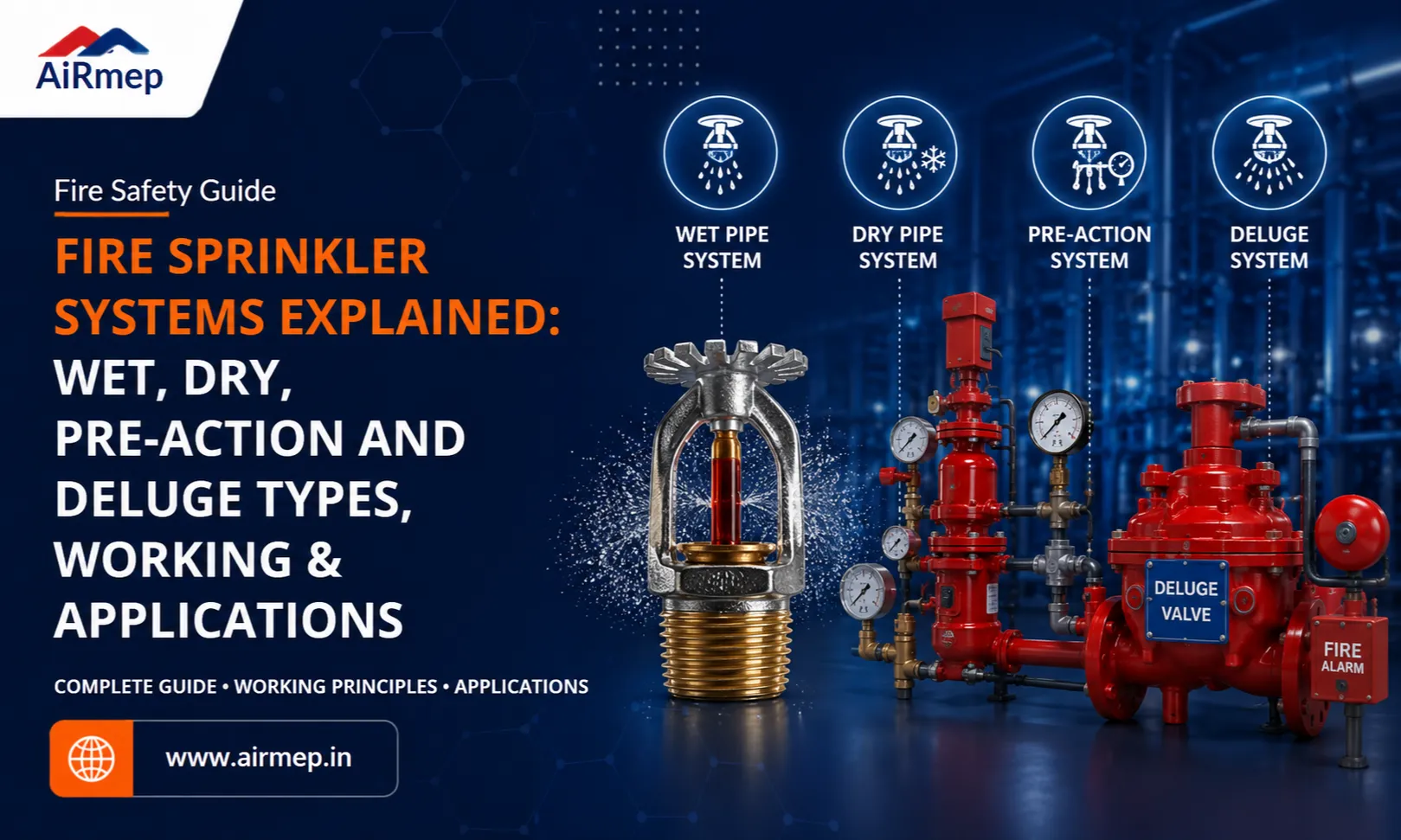
Fire Sprinkler Systems Explained: Wet, Dry, Pre-Action and Deluge Types, Working & Applications

Fire sprinkler systems are an active fire protection network, categorized into four types: wet pipe, dry pipe, pre-action, and deluge systems. Every system is made for a different purpose, environment, and hazard levels, that dictates whether the pipes are filled with water, pressurized air, or left empty unless fire is detected.
A fire causes devastating damage to your property, whether it is a home or commercial space. And if you wait until the fire rescue services arrive, it can lead to loss of assets and life itself. This highlights the need to install fire sprinkler systems in your homes, offices, or other properties. Also, with a proper understanding of different sprinkler types, such as wet pipe, dry pipe, pre-action, and deluge systems, you can choose the right fire sprinkler system suitable for your needs.
Table of Contents
What are Fire Sprinkler Systems?
Fire sprinkler systems are a proactive protection method, consisting of a water supply that is released during fire emergencies. These systems were initially used in factories and large commercial facilities, but now they are extensively utilized in residential buildings and homes.
Their history can be traced back to the 15th century, when Leonardo da Vinci created the prototype of a sprinkler for his patron’s kitchen. Later, after significant improvements in the mechanism by Frederick Grinnell and Henry S. Parmalee, the fire sprinkler systems were adopted as highly effective fire safety solutions.
Components of Fire Sprinkler Systems:
- Water Supply and Main Riser
- Control and Alarm Valves
- Piping Network
- Sprinkler Heads
- Auxiliary Components
Types of Fire Sprinkler Systems
There are four main types of fire sprinkler systems available for use, with each working on a specific principle to serve a different purpose.
| System | Pipes | Trigger | Best For |
| Wet Pipe | Water Filled | Heat | Offices |
| Dry Pipe | Air Filled | Heat | Cold Storage |
| Pre-Action | Dry Until Detection | Fire Detection + Heat | Data Centers |
| Deluge | Empty + Open Heads | Fire Detection | High Hazard Areas |
Take a thorough read through the fire sprinkler systems types:
1. Wet Pipe System
A Wet Pipe Sprinkler System is the most commonly used system, operating on a pressurized water supply and releasing water when needed. These systems feature a heat-sensitive sprinkler head or nozzle that discharges water in response to detected heat.
Main features of a Wet Pipe Sprinkler System:
- Immediate Response
- Independent Operation
- Cost-Effective
- Alarm Mechanism
Applications:
- Commercial Office Buildings
- Retail and Shopping Malls
- Residential High-Rises and Apartments
- Schools and Universities
2. Dry Pipe System
A Dry Pipe Sprinkler System is specifically designed for unheated or freezing environments, which means it stays hollow most of the time until fire breaks out. It remains empty with either pressurized air or nitrogen, and releases the water when needed.
Key Features of a Dry Pipe Sprinkler System:
- Freeze Protection
- Pressure Differential Valve
- Slight Response Delay
- Individual Sprinkler Head Activation
Applications:
- Cold Storage Facilities
- Parking Garages
- Loading Docks
- Unheated Warehouses
3. Pre-Action System
A Pre-Action Sprinkler System combines both mechanisms, wet and dry systems, to prevent accidental water damage in water-sensitive environments. The water is held behind a pre-action valve and is released upon fire detection. It features a fire alarm that signals the valve to release the water before individual sprinkler heads activate.
Pre-Action Sprinkler System Types:
- Single Interlock
- Double Interlock
- Non-Interlock
Primary features of a Pre-Action Sprinkler System:
- Dry Pipe Network
- Dual-Trigger Activation
- Supplemental Detection System
- Pre-Action Valve
Applications:
- Data Centers and Server Rooms
- Museums and Libraries
- Art Galleries
- Hospitals and Laboratories
- Archives and Record Rooms
- Telecommunication Facilities
4. Deluge System
A Deluge Sprinkler System is a high-volume fire suppression system that is operated entirely by a separate fire detection network. The deluge sprinkler system working principle is divided into three phases: standby mode, detection, and activation.
- Standby Mode: The pipes stay dry with open sprinkler heads. The central deluge valve keeps the pressurized water in the upper chamber.
- Fire Detection: Separate devices are installed, such as heat, smoke, flame, or optical sensors for fire detection.
- Activation: When a fire is detected, the releasing device opens the deluge valve, which allows the water to flow through the pipes, discharging it from all the open sprinkler heads or nozzles at the same time.
Core Features of a Deluge Sprinkler System:
- Open Sprinkler Heads
- Deluge Valve
- Independent Detection
- Rapid and Massive Discharge
- Compatible with Foam
Applications:
- Aircraft Hangars
- Power Plants and Transformers
- Chemical Processing
- Oil and Gas Refineries
- Warehouses
Why are Fire Sprinkler Systems Important?
Fire sprinkler systems are very important fire safety systems in both commercial facilities and residential buildings. They work by automatically detecting the fire in the environment and releasing water through sprinklers, reducing property damage and protecting lives.
They are important for the following reasons:
1. Life Safety and Quick Response
Fire sprinkler systems not only alert people about the emergency, but also take immediate action to stop it from spreading. When the heat typically reaches around 57°C and 68°C (135°F to 155°F), a heat-sensitive component in the sprinkler head breaks and releases the water quickly.
2. Controlled Operation with Minimized Water Damage
Modern fire protection sprinkler systems work independently and operate only in the required areas, reducing the water damage where it is not needed.
These independent fire protection systems use only around 8 to 24 gallons of water per minute, whereas a standard fire hose utilizes 50 to 125 gallons of water.
3. Property Protection
By using sprinkler fire protection systems, you can protect your commercial and residential property from fire and smoke damage. These systems protect your assets, such as computers, servers, heavy machinery, electronics, and irreplaceable sentimental items.
4. Insurance Benefits
Whether it is a commercial or residential facility, if it is equipped with fire suppression systems or sprinkler systems, they get many tangible and financial benefits like premium discounts from the insurance companies.
5. Reduced Environmental Impact
By stopping the fire from spreading out, these systems also help reduce the environmental impact by minimizing toxins, ash, carbon dioxide, and other greenhouse gases from spreading into the air.
Conclusion
Fire sprinkler systems are advanced fire suppression systems that provide significant protection from fire accidents. Whether commercial spaces, such as office buildings, healthcare facilities, retail spaces, or residential buildings and apartments, these systems help reduce fire damage and save lives. Fire sprinkler systems range in different types, each for a different use and applicability.
Airmep Sales Corp. is a trusted provider of HVAC products and Systems in India. From business to residential spaces, we provide every space with high-quality and reliable fire sprinkler systems, ensuring enhanced fire safety. While offering high-performing fire suppression products, we also provide essential technical support with timely delivery. Therefore, contact us today and get the best fire safety solutions.
Also Read: What is the Difference Between a Single and Double Interlock Preaction System?
Frequently Asked Questions:
How do fire sprinkler systems work during a fire?
Fire sprinkler systems work by detecting heat in the environment that triggers the glass bulb to break and spray water directly onto the fire.
What is the difference between a wet and dry sprinkler system?
A wet pipe sprinkler system is always filled with pressurized water for instant release, but a dry pipe sprinkler system remains hollow to prevent water from freezing in specific environments.
Can a fire sprinkler system go off by mistake?
Yes, a fire sprinkler system can go off by mistake, but only in rare incidents.
Which types of fire sprinkler systems are best for data centers, museums, and libraries?
Pre-action fire protection systems are ideal for data centers as they help protect sensitive instruments, electronic equipment, artifacts, and books from water damage.
How often should fire sprinkler systems be inspected and tested?
Fire sprinkler systems should be inspected and tested on a weekly, monthly, or quarterly basis.
What is a pre-action sprinkler system used for?
A pre-action sprinkler system is used to prevent accidental water damage in water-sensitive environments, such as data centers, libraries, museums, archives, art galleries, and telecommunication facilities.
Can I install an automatic fire sprinkler system in an existing building?
Yes, you can install an automatic fire sprinkler system in an already existing building, whether it is commercial or residential.
Are fire sprinkler systems activated by smoke or heat?
Fire sprinkler systems activate by detecting heat in the environment; they are non-reactive towards smoke.
What is the difference between a pre-action sprinkler system and a deluge sprinkler system?
A pre-action sprinkler system works on a two-step trigger principle, in which it detects the heat first, and the sprinkler head must be melted, whereas a deluge sprinkler system remains empty with the sprinkler head always open.
Do fire sprinkler systems damage electronics?
Yes, water-based fire sprinkler systems can damage the electronics.