info@airmep.in | +91-9810220896 | New Delhi, Delhi, 110015

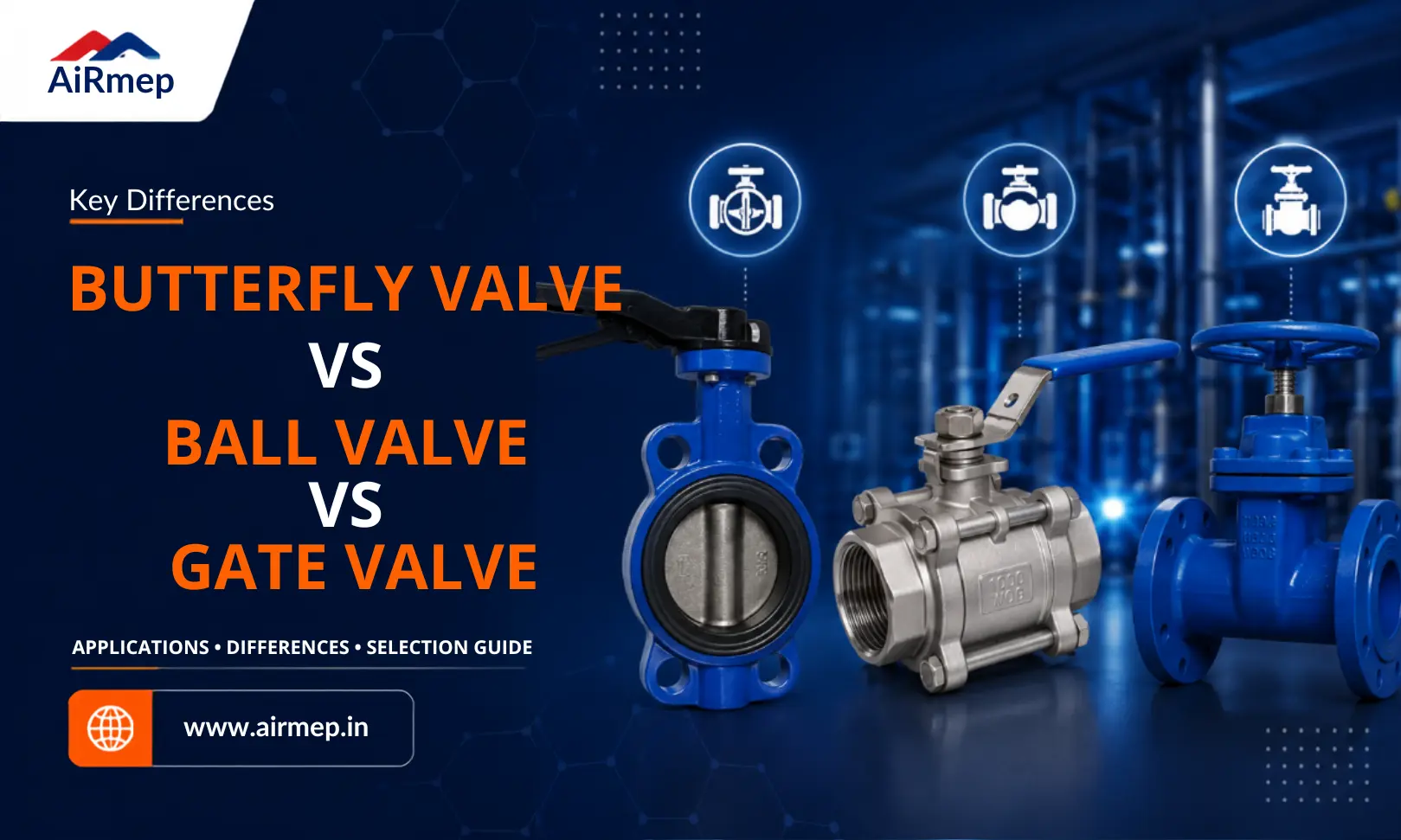
Butterfly Valve vs Ball Valve vs Gate Valve: Key Differences, Applications & How to Choose the Right Valve

When you compare butterfly valve vs ball valve vs gate valve, you will see that each type has unique mechanical properties that show how it works. Ball valves offer the best leak-tight seal and are perfect for high-pressure systems. Butterfly valves are used for large pipelines and areas with limited space, and gate valves are made for fully open or closed isolation at high temperatures.
Valves play a key role by controlling, stopping, and adjusting the flow of liquid, gases, and thick mixtures in many industrial processes. Choosing the right valve for your pipes is a must because the wrong one not only wastes your money but also results in dangerous leaks. So many options are available, and to select the perfect one for your applications, you need to compare butterfly valve vs ball valve vs gate valve.
If you don’t know how a butterfly valve differs from a ball or gate valve, how can you choose the right valve for your project? Read on this valve selection guide to know about these valves, their key features, differences among them, applications, and more.
Table of Contents
3 CommonTypes of Industrial Valves
Industrial valves are heavy-duty devices that work like switches for pipes. They control how liquids or gases move through pipelines. They are used to start, stop, redirect, and slow down the flow and help in maintaining safe operations. Here are the three common types of industrial valves:
What Are Butterfly Valves?
Before we compare gate valve vs butterfly valve vs ball valve, let us understand what butterfly valves actually do. These valves are used in pipelines to start, stop, and control the flow of liquids, gases, and slurries. They get their name because of a round, flat, metal disc that rotates on a central axis and looks just like butterfly wings.
- How It Works: A quick 90-degree twist or quarter turn of the handle rotates the internal disc. When the valve is fully open, the disc turns flat against the flow and allows the water or gas to pass easily. However, when it is fully closed, the disc turns perpendicular to the pipe and blocks the flow completely.
- Key Advantages: They only need a 90-degree turn to open or close, so they are very easy to use. They have a smaller and flatter shape that makes their installation faster, even in tighter spaces. When you compare ball valve vs gate valve vs butterfly valve, you will notice butterfly valves have fewer moving parts, so they are cheaper to manufacture and maintain than these large valves.
- Key Disadvantages: Although these valves are used in many applications, like water supply systems and HVAC products, they have some disadvantages. They are not designed for heavy-duty flow regulation. In some conditions, pressure drops can lead to pipe vibration and damage.
What Are Ball Valves?
In this industrial valve comparison, we will now discuss ball valves. This is a shut-off valve that controls the flow of liquids and gases using a rotating ball with a hole through a quarter-turn. These valves are known for their unmatched sealing performance and durability. They are used in residential plumbing, water treatment plants, and industrial piping systems.
- How It Works: These valves contain a ball with a hole drilled through its center. When you turn the handle 90 degrees, the ball rotates so that its hole aligns with the pipe, letting the water or gas flow freely. However, when you turn the handle another 90 degrees, the ball rotates in a way that the solid part blocks the pipe and instantly stops the flow.
- Key Advantages: When the valve is closed, it creates a very tight seal. You only need to turn the handle 90 degrees to shut the valve off instantly in an emergency. These valves are made from strong materials and maintain great sealing performance even after being heavily used or left inactive for years. Trusted HVAC products suppliers recommend ball valves for high-pressure systems.
- Key Disadvantages: The main difference between butterfly valve and ball valve is that you can’t use these valves for throttling. If you leave the handle half-open to slow the flow, the inside parts get easily damaged. Fluid can get trapped inside the ball cavity when the valve is closed. Debris and thick slurries can solidify and get stuck inside the valves.
What Are Gate Valves?
In this valve selection guide, we are now discussing gate valves that are used to completely start or stop the flow of fluid in a pipeline. This means they can never be used for regulating the flow. When fully open, the gate leaves the pipe completely clear for an unrestricted flow. These valves have a flat, wedge-shaped barrier (gate) that blocks or clears the path of the liquid or gas.
- How It Works: These valves control the flow of fluids by moving a solid metal gate up and down inside a pipe. When you turn the handwheel, it raises or lowers the gate. Lowering creates a solid barrier and stops the fluid flow. However, raising it pulls the gate and clears the path for the flow. These are used in wastewater systems, large pipelines, and water treatment plants.
- Key Advantages: When you compare a gate valve vs butterfly valve, you will notice they provide excellent sealing when fully closed. Moreover, compared to ball valves, they provide a much larger, unobstructed flow area. This makes them perfect for thick fluids or pipelines that need maximum capacity.
- Key Disadvantages: The main difference between ball valve and gate valve is that these are slower than the former. Their opening and closing require multiple turns of the wheel, while ball valves only need a 90-degree turn. They must be kept completely closed or open, as keeping them partially open can cause damaging vibrations and damage to the seal.
Butterfly Valve vs Ball Valve vs Gate Valve: Key Differences
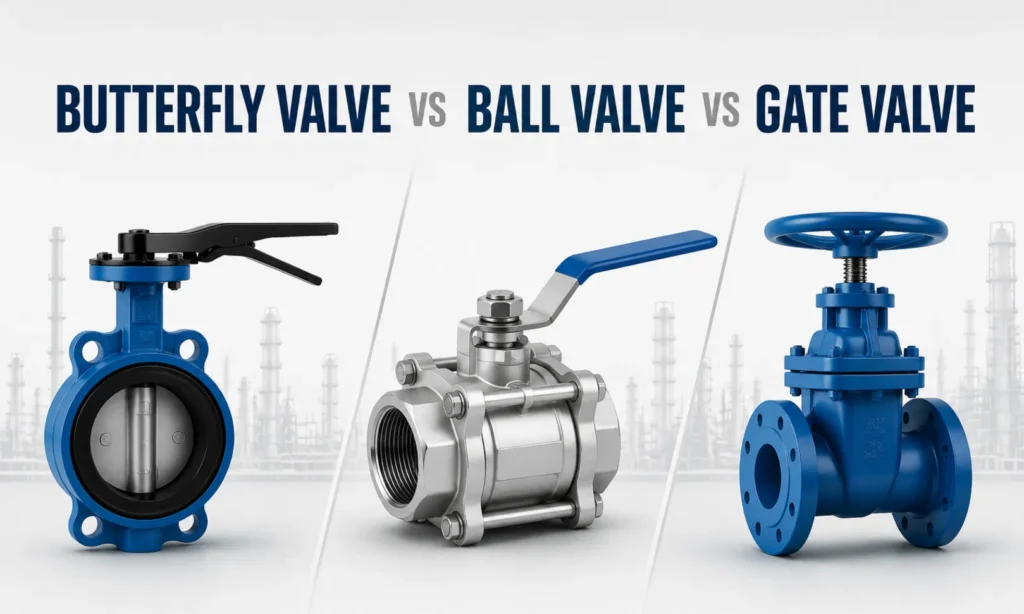
You can only choose the best valve for your industrial applications if you know the key differences between the three main types of valves. Ball valves offer leak-proof sealing, butterfly valves are great because of their space-saving design, and gate valves provide full flow. Here is the comparison among butterfly valve vs ball valve vs gate valve that will help you make the final choice:
| Valve Type | How It Works | Main Advantages | Common Applications |
| Butterfly Valve | Uses a rotating disc to start or stop the flow with a 90° turn. | Lightweight, compact, affordable, and easy to install. | Water treatment, HVAC, fire protection, and large pipelines. |
| Ball Valve | Uses a rotating ball to start or stop the flow with a 90° turn. | Leak-proof sealing, quick operation, ideal for high-pressure systems. | Oil & gas, chemical plants, water systems, high-pressure pipelines. |
| Gate Valve | Uses a sliding gate to completely open or close the flow. | Full flow with minimal pressure loss and excellent sealing. | Water distribution, power plants, mining, and industrial pipelines. |
1. Mechanism and Operation
- Butterfly Valve: They operate with a quarter-turn and use a round disc attached to a central shaft that rotates 90 degrees to open or block the flow.
- Ball Valve: They operate through a quarter-turn lever that rotates a ball with a hole through it to open or close.
- Gate Valve: They use a multi-turn handwheel to lift or lower a solid metal wedge (the gate) to clear or block the fluid path.
2. Flow Control and Sealing
- Butterfly Valve: This features a disc that constantly remains in the flow path and causes a slight pressure drop. Good for low-pressure sealing and light throttling.
- Ball Valve: Excellent bubble-tight sealing and must not be used for prolonged throttling. They handle high pressures well and provide a full-bore flow path when fully open, resulting in zero pressure drop.
- Gate Valve: Unmatched sealing when closed, and can never be used for throttling. When it completely leaves the flow path, the straight-through flow causes zero pressure drop.
3. Space and Weight
- Butterfly Valve: When you compare a butterfly valve vs ball valve, you will notice that these are very compact and lightweight. They need much less installation space than ball valves.
- Ball Valve: The main difference between butterfly valve and ball valve is that the latter ones are very large in size. They are much heavier than butterfly valves.
- Gate Valve: Comparison of butterfly valve vs ball valve vs gate valve in terms of weight, gate valves are the heaviest due to the mechanism needed to lift and lower the gate. So, their installation demands are more.
4. Best Applications
- Butterfly Valve: Water treatment facilities, HVAC systems, and municipal pipelines where installation space is tight.
- Ball Valve: Oil and gas pipelines, high-pressure industrial systems, and applications requiring zero leakage.
- Gate Valve: Pipelines where valves remain in one position for long periods, and situations where sealing is the most important requirement.
5. Cost and Maintenance
- Butterfly Valve: Generally, the most cost-effective and affordable choice due to its simple design and fewer moving parts.
- Ball Valve: More expensive than a butterfly valve for large pipelines, but they need very little maintenance.
- Gate Valve: More expensive and difficult to maintain, as they have more moving parts and take a longer time to operate.
6. Pressure Handling
- Butterfly Valve: Moderate to high range, but not used in extreme ultra-high-pressure scenarios.
- Ball Valve: Highly reliable for high-pressure systems.
- Gate Valve: Handles the highest pressures effectively.
How to Choose the Right Valve for Industrial Applications
Whether you are choosing Victaulic preaction valves for fire protection systems or valves for your industrial processes, you must know how to select the right one. You need to focus on points like what its size is, what fluid it will control, and more.
1. What is the Valve’s Job?
You should choose your valve based on what you need to do. You must choose a ball valve to simply stop and start the flow. If you need a valve to regulate how much fluid passes through, you must go with a globe or a butterfly valve.
2. What Fluid is It Controlling?
It is very important to understand that you can’t use the same valve to control different types of chemicals. You must choose the valve material that safely handles your specific fluid without rusting or breaking down. A trusted Victaulic fire protection products and valves supplier helps you confirm that the internal parts, like the valve seal, don’t corrode or melt from the chemicals passing through them.
3. How Hot or Pressurized is the System?
All industrial and fire protection valve products have a limit. You must check the maximum temperature and pressure that your pipes will ever reach. Then make sure you choose a valve that has a rating higher than your system’s maximums to prevent leaks or failures.
4. Does It Fit?
When deciding how to choose the right valve, make sure the valve you select matches your pipe size. When you choose a butterfly valve, ball valve, or gate valve with the correct size, you benefit from smooth flow, prevent pressure loss, and deliver the required flow rate.
5. How Will It Be Operated?
You need to make a choice based on how you want to turn the valve on and off. Manually, you can turn off valves using a lever or wheel. You can choose the best valve for industrial applications that are now available with automatic control (turned by an electronic or air-powered mechanism).
6. Is It Easy to Maintain?
Another important factor in how to choose the right valve is maintenance. Compare how often butterfly valves, ball valves, and gate valves require servicing. You must check if their replacement parts are easily available. Choosing a valve that is easy to maintain can reduce costly shutdowns.
Butterfly Valve vs Ball Valve vs Gate Valve: Which One to Use?
When you know how to choose the right valve for your piping system, you can easily avoid costly mistakes and meet required safety and performance requirements. If you usually work in small spaces, you must go with butterfly valves. However, ball valves are the best option for handling high pressures.
- Choose a Ball Valve if you require a long service life, fast operation, and high-pressure tight shut-off. These are best for leak-proof isolation.
- Choose a Butterfly Valve if budget and space constraints are your top priorities. They are the most cost-effective and easiest to install.
- Choose a Gate Valve if your priority is a straight-through flow with minimal pressure drop, or for mainline isolation where the valve will remain open for a long period.



Get Top-Tier Valve Solutions from Airmep Sales Corp.
Whether you are setting up a fire system or a commercial plant, by choosing the correct one, you can avoid so many problems. You must consider factors, like pressure, space, and how often the valve will be used, to make the final choice. Get expert help for the best valve selection for your applications from Airmep Sales Corporation.
Our team will help you select the right valves for your project needs. We are a trusted and authorized dealer for top global brands, like Victaulic. Working with us gives the guarantee that you will always get genuine and high-quality industrial and fire protection valve products. We also offer our clients by offering installation support. Contact the Airmep Sales Corporation team to find the perfect valves for your business.
Frequently Asked Questions (FAQs)
1. What is the main difference between a butterfly valve, ball valve, and gate valve?
When you compare Butterfly Valve vs Ball Valve vs Gate Valve, you will see that the main difference lies in their design and operation. Butterfly valves use a rotating disc, ball valves use a rotating ball with a bore, and gate valves use a sliding gate to control fluid flow.
2. Which is better: a butterfly valve vs ball valve?
This depends on what your need is. A butterfly valve is better for large pipelines and limited installation space, while ball valves are the best choice for high-pressure systems that need a leak-proof seal.
3. When should you use a gate valve?
Gate valves are best used for on/off isolation in pipelines where the valve remains either fully open or fully closed.
4. Can a gate valve be used for flow control?
Gate valves must never be used for throttling or regulating flow. They are designed to operate either fully open or fully closed, as partial opening can damage the valve and reduce its service life.
5. Can Airmep help with the right valve selection?
When you connect with the Airmep Sales Corporation team, you get expert support for valve selection, access to a range of top-grade products, and installation help.