info@airmep.in | +91-9810220896 | New Delhi, Delhi, 110015

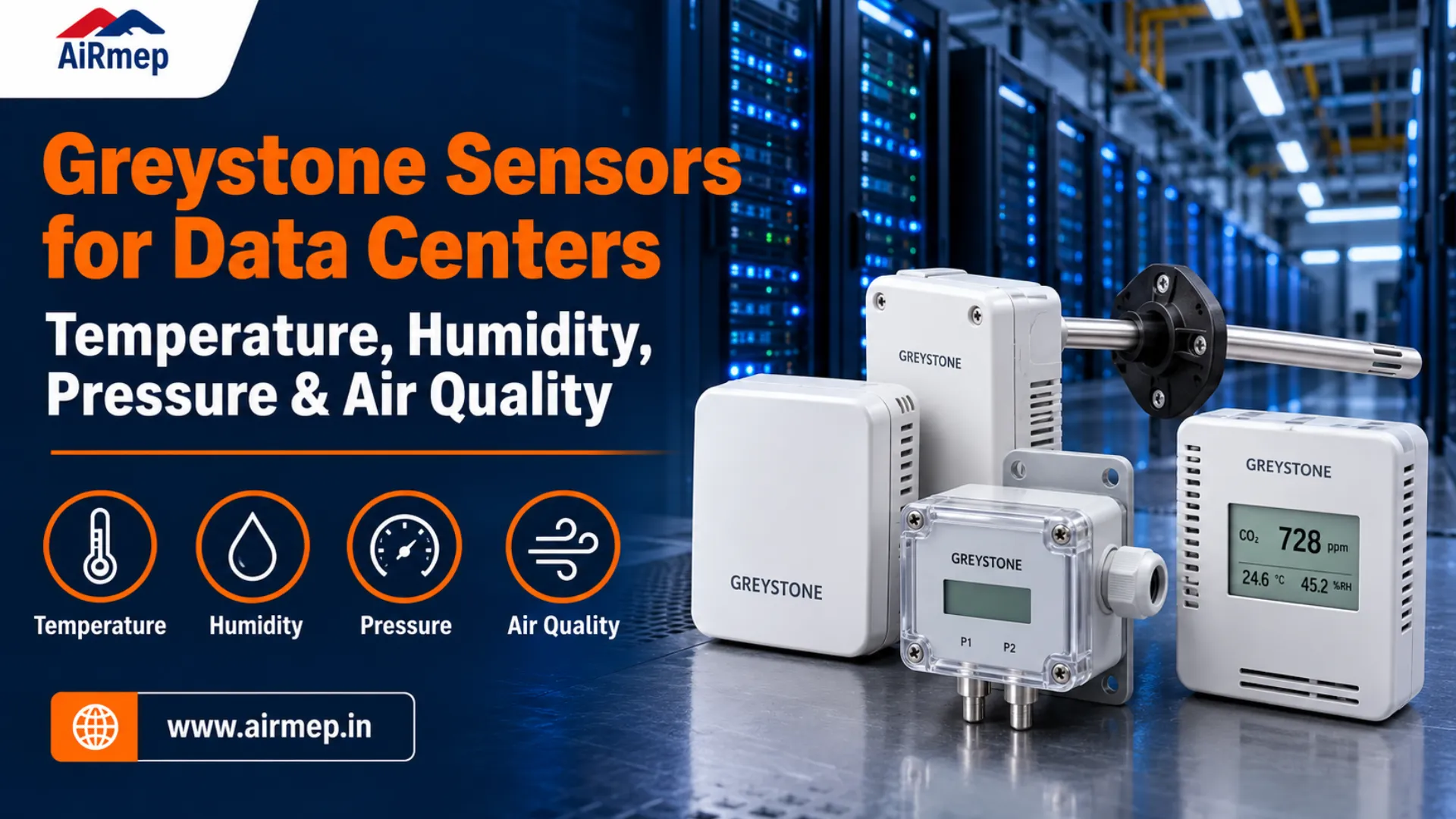
Greystone Sensors for Data Centers: Temperature, Humidity, Pressure & Air Quality

Greystone sensors for data centers monitor environmental conditions, including temperature changes, relative humidity, air quality, and pressure, to keep the IT infrastructure operational.
Data centers need to have well-monitored environmental conditions so the servers and other IT equipment keep working properly. Greystone sensors for data centers, in this case, stand out by providing accurate environmental measurements to help identify abnormal conditions, optimize cooling, and reduce the risks of equipment-related issues. These precision monitoring systems provide accurate measurements of temperature, humidity levels, and air pressure and quality.
Explore our range of Greystone HVAC sensors and controls to find suitable environmental monitoring solutions for your data center.
Table of Contents
Why Is Environmental Monitoring Important in Data Centers
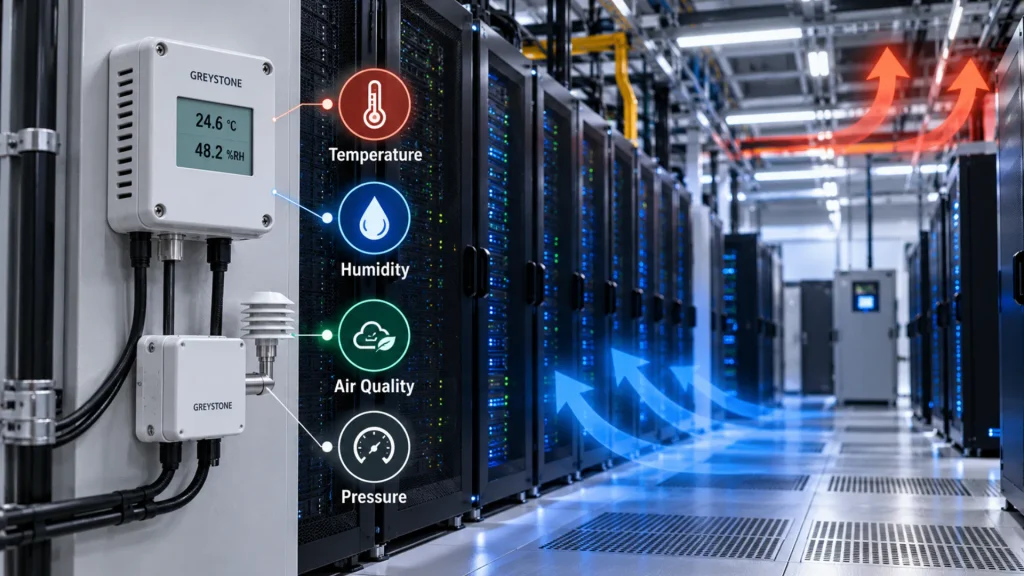
Monitoring environmental conditions in data centers is important to prevent damage to the critical equipment and other IT infrastructure. Apart from the standard protection from overheating, Greystone data center sensors are capable of protecting the facility from more subtle dangers such as humidity, air pressure, and air quality as well.
- Helps Reduce Costly Downtime: Monitoring environmental conditions through Greystone sensors can help reduce the risks of power and cooling failures and protect sensitive data.
- Supports Equipment Longevity: These sensors can help prevent IT hardware from overheating, component wear, and electrostatic damage, which may extend its life.
- Lowers Energy Costs: This also reduces the need for frequent use of power for cooling systems, reducing huge electricity bills.
- Improves Capacity Planning: Monitoring also provides operators with historical data that helps them plan where cooling or power is most needed before adding new servers.
What Do Greystone Temperature Sensors Monitor in Data Centers
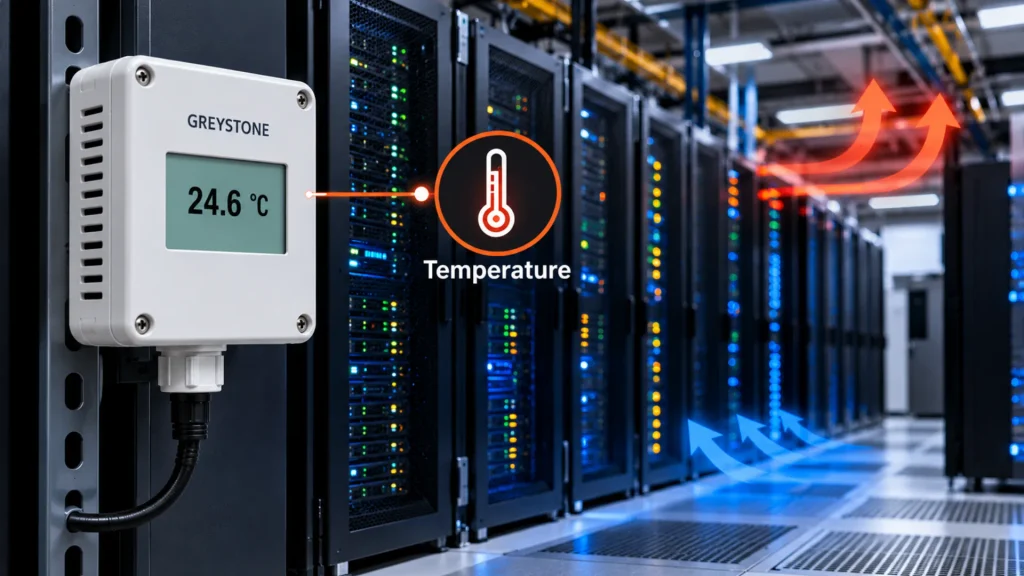
Greystone temperature sensors for data centers are industrial-grade devices that monitor heat levels in air ducts, server rooms, and other areas of an IT facility.
- Rack and Server-Room Temperature: Monitors temperature across the server rooms with specific metal cabinets (racks) where sensitive hardware is placed.
- Supply and Return Air: It also monitors the air conditioning systems to make sure that they are also working well.
- Hot and Cold Aisle Monitoring: Well-positioned sensors measure the supply, intake, and exhaust temperatures.
How Do Greystone Humidity Sensors Help Monitor Data Center Conditions
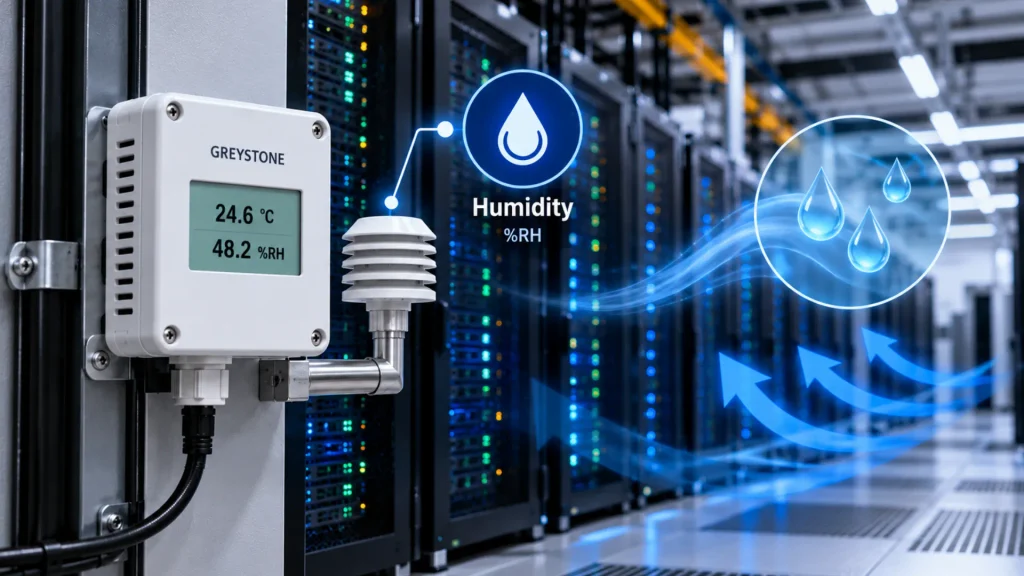
Greystone humidity sensors for data centers also measure the levels of humidity in the environment to prevent equipment failure and control static electricity.
- Relative Humidity: These sensors help maintain safe levels of humidity in the environment, so the equipment keeps working properly.
- Condensation Risk: The sensor types that can calculate dew point may help the operators look for condensation risks by comparing readings with specific surface temperatures.
- Static Electricity: These sensors monitor relative humidity, that help the operators maintain optimal environmental conditions and manage the risks of electrostatic discharge.
How Are Differential Greystone Pressure Sensors Used in Data Center HVAC
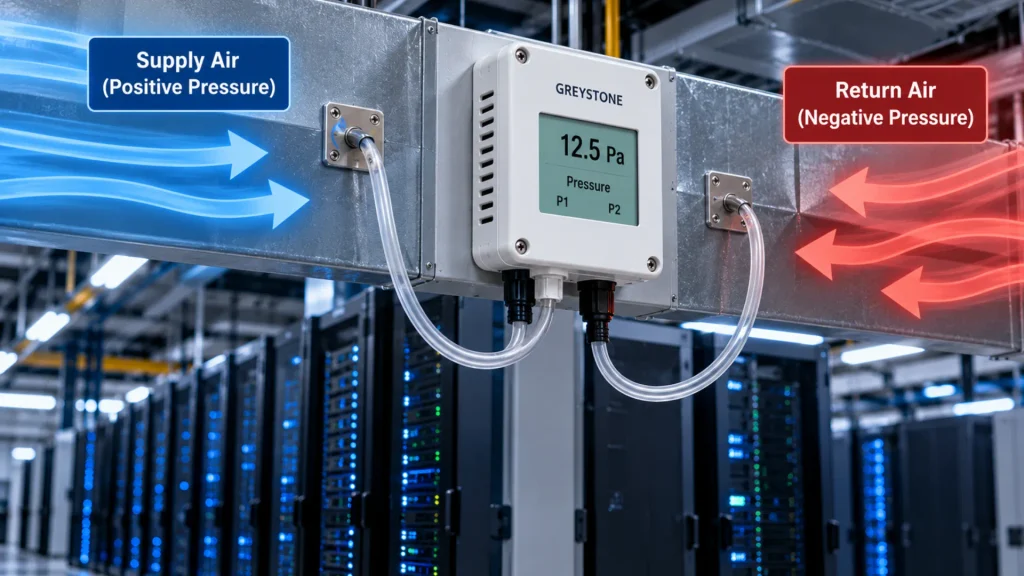
Greystone pressure sensors are also used in data centers to monitor air, gas, or liquid pressure levels in the facility’s HVAC systems.
- Differential Pressure: These sensors actively detect abnormal differential pressures in the HVAC systems of data centers.
- Filter Monitoring: Also monitors filters to identify increased resistance, signifying when they are dirty or clogged, without having them pulled out for manual checks.
- Airflow and HVAC Systems: Continuously monitors airflow conditions and can help the team assess the Heating, Ventilation, and Air Conditioning (HVAC) system operations.
Which Greystone Air Quality Parameters Can Data Center Sensors Monitor
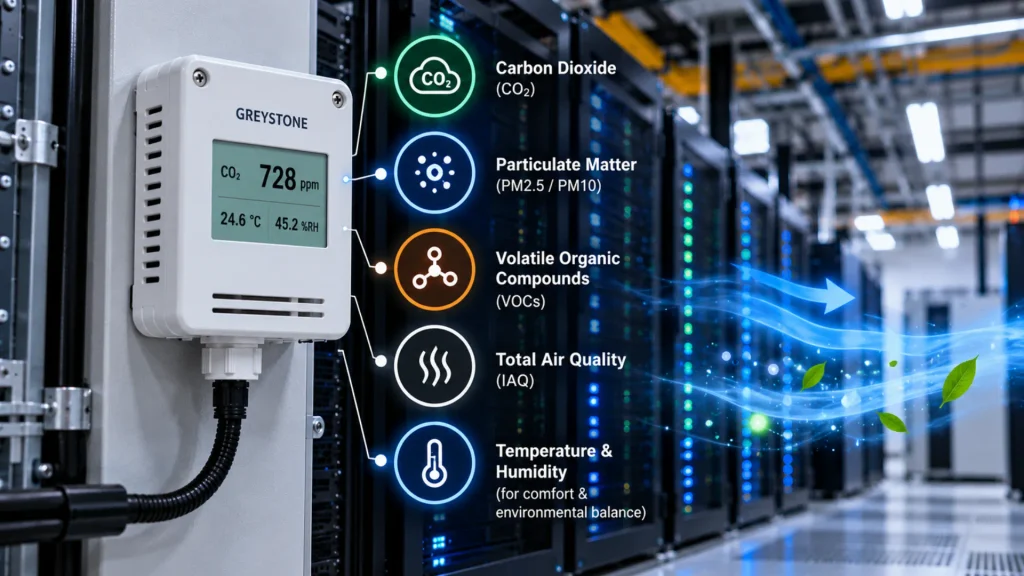
Greystone air quality sensors measure air quality by tracking parameters such as volatile organic compounds (VOCs), carbon dioxide, humidity, and temperature fluctuations.
- CO₂: Monitors carbon dioxide levels to support ventilation and air quality in the facility.
- VOCs: Detects volatile organic compounds that can indicate changes in indoor air quality.
- Particulate Matter: Many Greystone models can measure particulate matter such as PM2.5 where such a feature is provided.
How Do Greystone Sensors Integrate With HVAC and BMS Systems
Greystone sensors support data center HVAC (Heating, Ventilation, and Air Conditioning) by providing highly accurate data on temperature, air pressure, air quality, and humidity. This helps these systems maintain optimal conditions needed to keep the equipment safe and operating efficiently. Explore our wider range of HVAC products and solutions for commercial and industrial building systems.
Furthermore, by integrating with the building’s BMS (Building Management System), these devices can provide 4–20 mA or 0–10 V signals, as per the specific model chosen, which makes communication possible with the HVAC controllers across data center facilities.
In addition, some models of Greystone data center HVAC sensors can connect with BMS platforms through BACnet, Modbus, or analog signals, allowing HVAC conditions to be monitored and controlled easily in real time.
Where Should Environmental Sensors Be Installed in a Data Center
Look at the table below to understand where you can install the Greystone sensors for data centers:
| Area | Sensor Placement | Purpose |
| Server Rack: Front Intake | Top, middle, and bottom of the rack | Monitor incoming air temperature |
| Server Rack: Rear Exhaust | Top, middle, and bottom of the rack | Track exhaust heat and hot spots |
| Cold Aisles | Along the aisle, near server air intakes | Check cold air delivery |
| Hot Aisles | Near server exhausts and return air paths | Monitor heat buildup |
| CRAC and CRAH Units | At unit air intakes, supply ducts, and return ducts | Monitor cooling performance |
| Air Ducts | Inside supply and return ducts | Measure airflow and pressure |
| Raised Floors and Underfloor Spaces | Beneath raised floors, near pipes and cooling units | Effectively monitor pressure |
| Mechanical Rooms | Near chillers, pumps, and cooling equipment | Monitor equipment conditions |
| Electrical Rooms and Power Panels | At PDUs, RPPs, and electrical distribution panels | Monitor ambient temperature around electrical equipment |
| Ceilings and Return Air Areas | Near ceiling-level return air paths and designated fire protection zones | Monitor return-air temperature and environmental conditions |
How Do You Select the Right Greystone Sensor for a Data Center
To choose the right Greystone sensors for data centers, consider whether they meet your specific environmental requirements, such as temperature, humidity, pressure, and especially the Computer Room Air Conditioner (CRAC) unit performance.
Here is how you can choose the right Greystone sensor for your data center:
Temperature Sensors
- Choose a highly accurate room or micro-temperature sensor to ensure close monitoring of intake and exhaust temperatures.
- You can also choose rigid probe or averaging duct temperature sensors that track air-conditioned delivery.
Humidity and Dew Point Transmitters
- Choose advanced combination units that efficiently help measure optimal humidity levels to protect the critical IT infrastructure.
- Make sure that the device uses thermoset polymer-based capacitive sensors, helping resist chemical contaminants.
- To manage condensation risks on pipes and cooling beams, ensure that the specific model you buy calculates dew point and wet-bulb temperature internally.
Air Quality and Differential Pressure
- Select the Greystone air quality sensors that can efficiently monitor particulate matter and carbon dioxide levels, particularly in areas and server rooms where maintenance occupancy changes constantly.
- Several models track airflow and pressure differences across containment zones to support cooling and reduce unwanted air mixing.
Communication and Signal Compatibility
- Choose the specific Greystone sensor models that are equipped with the native communication protocols or standard analog outputs.
- Select the specific series that can help monitor sensitive conditions in the data centers with greater precision and accuracy.
Where Can You Buy Greystone Sensors for Data Centers in India



Airmep Sales Corp. is a reliable provider of Greystone products for HVAC systems in India. As an ISO-certified supplier, we provide a range of Greystone sensors, whether room and duct or outdoor and immersion models; you can get what suits your specific facility needs.
You can trust us, as we offer:
- BMS Integrated Products
- Wider Range of Models
- Expert Technical Support
- Reliable Local Availability
- Complete After-Sales Support
If you are not sure what would suit your requirements, you can connect with our professional team as well. They are well equipped with technical knowledge and will assist you through a variety of options available. Thus, reach out to us today to get highly accurate and high-quality Greystone sensors for data centers.
Also Read: CO Sensor vs CO2 Sensor: What’s the Difference?
Frequently Asked Questions About Greystone Data Center Sensors
Can Greystone sensors be installed into an existing data center?
Yes, Greystone sensors can be installed into an existing data center.
How often should data center sensors be calibrated?
The calibration of Greystone sensors depends on the specific sensor type and operating environment.
Can Greystone sensors detect water leaks near server racks?
No, standard Greystone temperature, humidity, pressure, and air quality sensors cannot detect water leaks. A dedicated water leak detection sensor is required for this purpose.
Do Greystone sensors work with third-party BMS controllers?
Yes, Greystone sensors can work with third-party BMS controllers.
What should I check before buying Greystone sensors for a data center?
Things you should check before buying Greystone sensors for a data center: Measurement Range, Accuracy, Output Signal, Communication Protocol, Mounting Type, and Environmental Conditions.