info@airmep.in | +91-9810220896 | New Delhi, Delhi, 110015

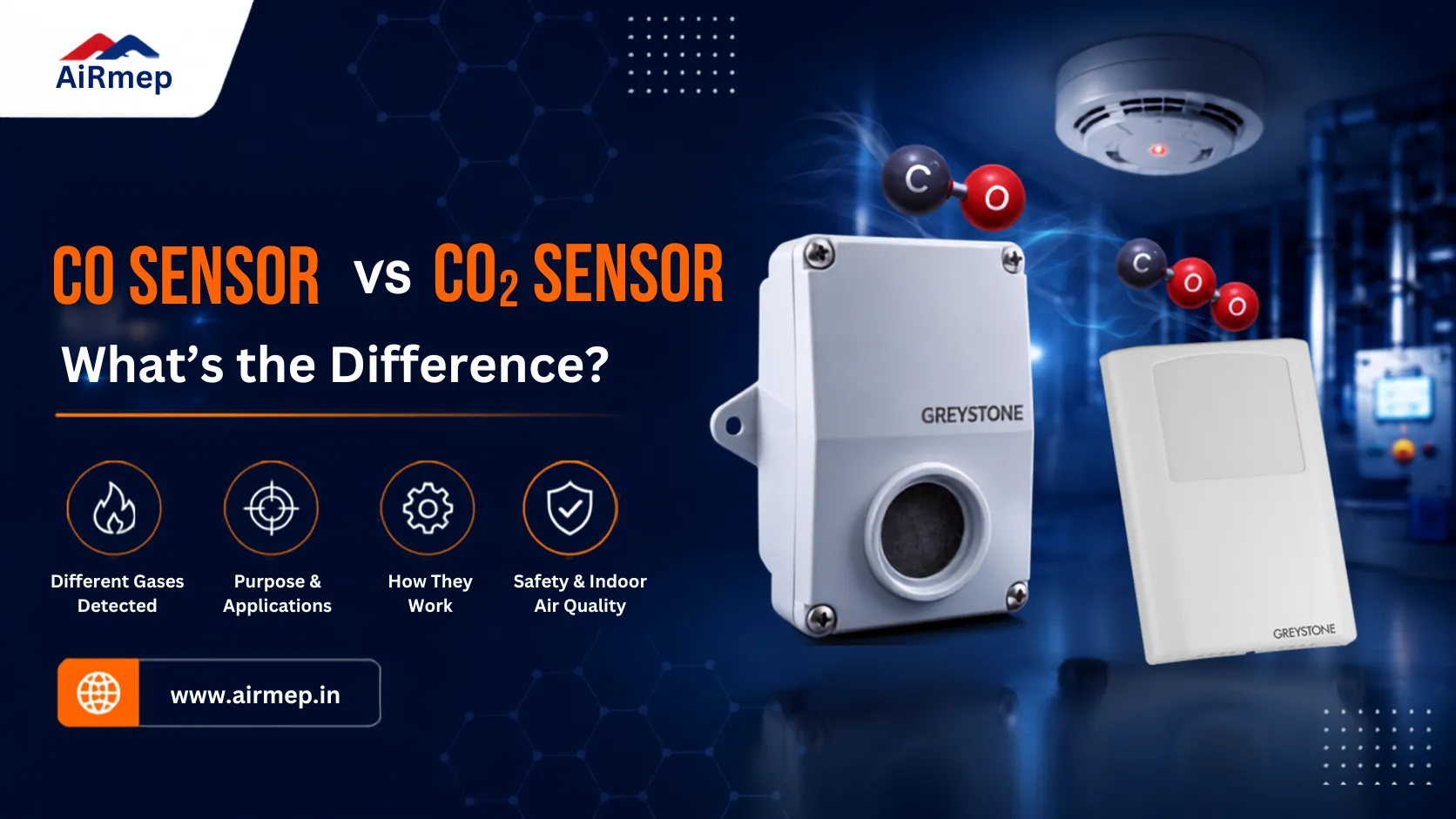
CO Sensor vs CO2 Sensor: What’s the Difference?

A CO sensor is responsible for detecting carbon monoxide, a toxic, deadly gas emitted from bad fuel combustion. While a CO2 sensor measures the levels of carbon dioxide, mainly in public spaces and buildings. Both sensors are different based on the type of gas detection, technology, mechanism, and how they ensure safety in distinctive ways.
Carbon Monoxide (CO) and Carbon Dioxide (CO2) sensors are both used in public and commercial places to detect the concentration of specific gases in the air. A CO sensor detects carbon monoxide, which is a toxic and lethal gas, whereas a CO2 sensor measures the levels of carbon dioxide in the air, mainly caused by engines, respiration, and other sources.
Moreover, the CO Sensor vs CO2 Sensor difference becomes important because both use different technology of detection of a specific gas in the environment. By looking at their features in detail, their applications, limitations, and differences, you can efficiently use both devices based on your specific requirements.
Table of Contents
What Is a CO Sensor?
A Carbon Monoxide (CO) sensor refers to an electronic device that measures the levels or concentration of carbon monoxide gas in the environment. Carbon monoxide is a colorless, odorless, and tasteless gas, making it impossible to detect by human senses. For this reason, a CO sensor for HVAC systems is used for monitoring and ensuring safety.
What Is a CO2 Sensor?
A CO2 sensor is an electronic device that is used to measure the concentration of carbon dioxide gas in the environment. Just like carbon monoxide, CO2 is also a colorless, tasteless, and odorless gas, triggering no warning signs for human senses. This sensor measures CO2 in parts per million (ppm) and is used in buildings, offices, homes, and other spaces.
CO Sensor vs CO2 Sensor: Key Differences
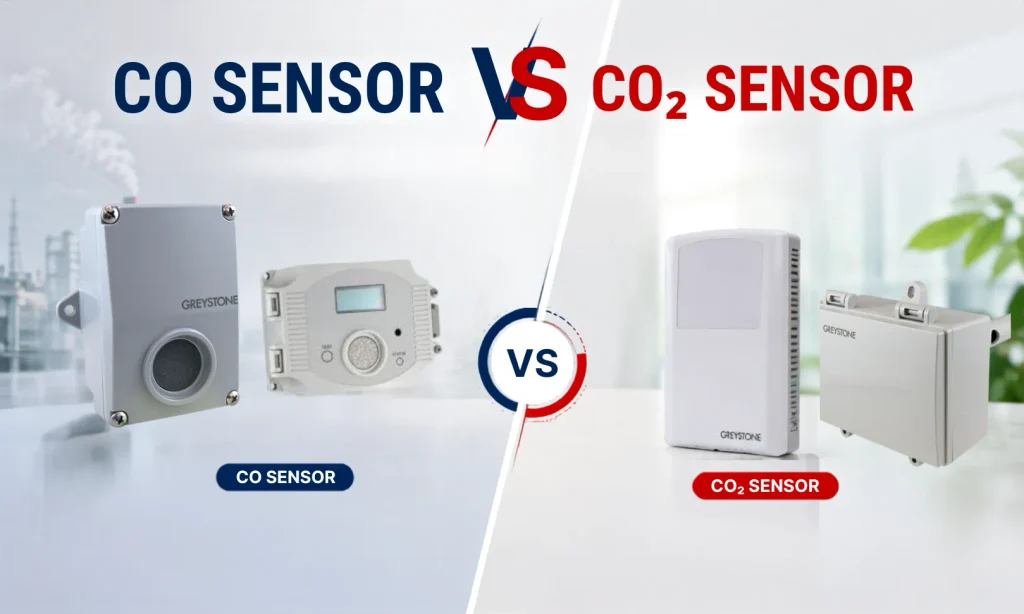
A CO sensor and CO2 sensor differ based on their target gas detection, technology, use case, and measurement scale.
Look at the table below to understand the difference between CO and CO2 sensor:
| Feature | CO Sensor | CO2 Sensor |
| Gas Detected | Carbon monoxide (CO) | Carbon dioxide (CO2) |
| Main Source | Incomplete combustion of fuels | Human respiration and combustion |
| Primary Hazard | Toxic and potentially fatal when inhaled | Harmful at high concentrations; can cause drowsiness and impaired breathing |
| Common Applications | Homes, garages, boilers, furnaces, and industrial areas | Offices, schools, HVAC systems, greenhouses, and vehicles |
| Typical Purpose | Detects dangerous CO leaks for safety | Monitors CO2 concentration and indoor air quality |
| Common Sensor Technologies | Electrochemical, metal-oxide semiconductor | NDIR (Non-Dispersive Infrared), mainly |
| Measurement | Usually measured in ppm | Usually measured in ppm |
| Key Difference | Focuses on poisonous CO exposure | Focuses mainly on CO2 concentration and ventilation |
How Do CO and CO2 Sensors Work?
A CO sensor for HVAC systems constantly monitors the air quality for carbon monoxide concentration in it. When its components sense the presence of CO in the surrounding air, it turns that into an electrical signal. When the amount of CO exceeds a safe threshold in the environment, it then triggers the alarming systems.
On the other hand, a CO2 sensor also monitors the surrounding atmosphere for carbon dioxide gas. But it works a bit differently compared to a CO sensor. It works by shining an invisible infrared light through the air and measures the concentration of CO2 in the atmosphere. If there is CO2 in the air, it will absorb a specific wavelength of infrared light of around 4.26 micrometers.
Where Are CO and CO2 Sensors Used?
Look at the table below to understand the applications of CO and CO2:
| Sensors | Applications | Common Use | Key Benefit |
| CO Sensors | Homes, parking garages, boilers, industrial facilities, and automotive areas | Detect carbon monoxide leaks | Prevents CO poisoning and improves safety |
| CO2 Sensors | Offices, schools, hospitals, greenhouses, and HVAC systems | Monitor CO₂ levels and ventilation | Improves indoor air quality and ventilation |
| CO and CO2 Sensors | Commercial buildings, manufacturing facilities, laboratories, and smart buildings | Monitor both gases simultaneously | Provides comprehensive air-quality monitoring |
When Do You Need Both CO and CO2 Sensors?
You need to use both a CO sensor and CO2 sensor when you have a space or facility featuring fuel-burning machines and need proper ventilation to ensure safe air for people breathing there.
Here are the places where we need both sensors:
- Indoor Air Quality (IAQ) and Ventilation Control
- Indoor Boiler Rooms and Mechanical Spaces
- Breweries, Wineries, and Cellars
- Greenhouses and Indoor Farming
- Parking Garages and Tunnels
How to Choose the Right CO or CO2 Sensor?
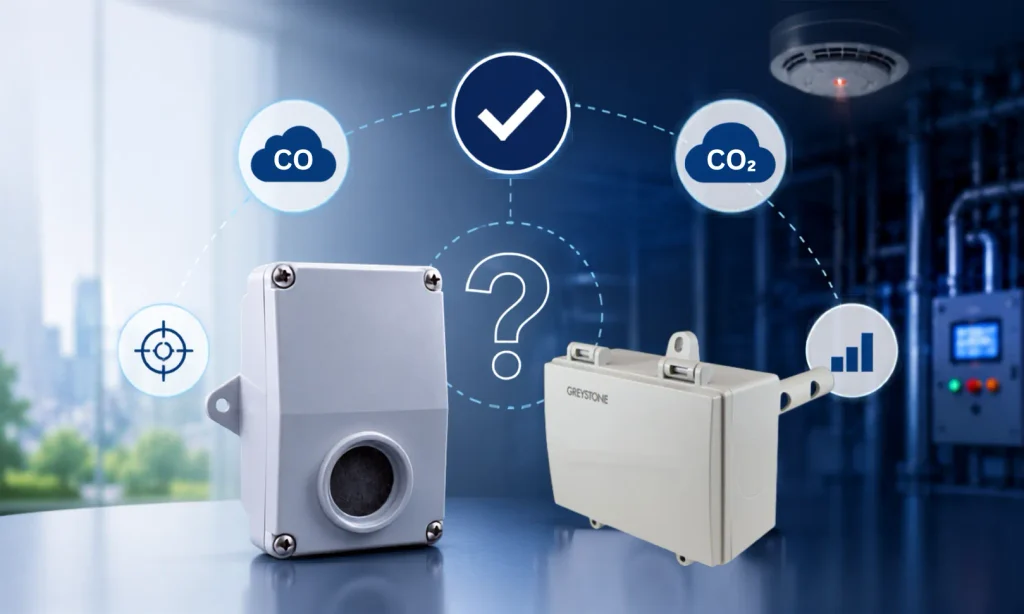
Go through the steps mentioned below to understand how you can choose the right kind of CO and CO2 sensors:
1. Identify the Gas Detection and Purpose
The first step is to decide what gas you want to detect: CO or CO2. To detect carbon monoxide (CO) gas, you can choose from two types, including electrochemical or metal oxide semiconductor (MOS) sensors. But if you want a CO2 sensor, consider Dispersive Infrared (NDIR) sensors that are well-known for their accuracy and longevity.
2. Match the Measurement Range (PPM)
- For Indoor Air Quality: Choose a CO2 sensor with a range of 0 to 10,000 ppm (0 to 1%), which is good for ventilation threshold tracking.
- For Commercial Safety: Consider selecting wider-range sensors, like 0 to 5% or higher, as commercial facilities such as restaurants, breweries, and other confined spaces are at high risk during dangerous accidents due to CO2 leaks.
3. Evaluate Sensor Technology and Lifespan
When choosing a CO and CO2 sensor, consider the specific technology used for measurement and its lifespan, as many sensors require regular maintenance and are prone to environmental shifts.
- Typical Lifespan of CO Sensors: 5 to 7 years
- Typical Lifespan of CO2 Sensors: 5 to 15 years
4. Power and Integration Needs
A CO sensor and CO2 sensor have different power requirements and integration methods, as they both use different technologies. Thus, choose the right types based on your requirements.
Why Choose Airmep as a supplier for CO and CO2 Sensors for Greystone products?
Airmep Sales Corp. is a reputable supplier of HVAC and fire solutions across India. You must choose us as a supplier of CO and CO2 sensors for the following reasons:
- Authentic Products: Airmep provides high-quality Greystone CO sensor and CO2 sensor across India, ensuring superior protection and air quality control.
- Technical Support: Our highly experienced team provides complete technical support, such as configuration and calibration assistance for CO and CO2 sensors.
- Local Expertise: As a trustworthy local supplier of CO and CO2 sensors, we understand local requirements and provide tailored solutions.
- Fast Delivery: We also ensure that our products are securely transported and reach your specified destination on time.



Conclusion
CO and CO2 sensors are widely used in HVAC product systems for monitoring air quality levels in the environment. CO sensors detect the toxic carbon monoxide, while CO2 sensors measure carbon dioxide concentrations. Both devices serve distinct purposes and differ based on their detection technology, target gas, and applications.
If you are searching for reliable CO and CO2 sensor suppliers in India, connecting with Airmep Sales Corp. can be a smart choice. We are a reputable supplier of HVAC solutions, offering high-quality CO and CO2 sensors for both residential and commercial uses. With years of industry experience, we ensure timely delivery and expert after-sales support. Therefore, reach out to us and get the best CO and CO2 sensors for your HVAC needs.
Also Read: What Is an Expansion Joint in HVAC Systems? Types, Benefits & Applications
Frequently Asked Questions:
1. Can a CO sensor for HVAC systems detect CO2?
No, a CO sensor for HVAC systems is not designed to detect CO2.
2. Which CO sensor is the most reliable for home safety?
Electrochemical CO sensors are considered reliable for home safety. Also, choosing a certified CO alarm that meets applicable safety standards, such as UL 2034, is highly recommended.
3. What is the CO sensor vs CO2 sensor difference?
A CO sensor detects carbon monoxide, while a CO2 sensor is used for measuring the levels of carbon dioxide gas in the environment.
4. What are the applications of a CO2 sensor?
Here are the main applications of CO2 sensors:
– Indoor Air Quality (IAQ) and HVAC
– Agriculture and Horticulture
– Medical and Life Sciences
– Environmental Research
– Industrial and Workplace Safety
5. How often should CO and CO2 sensors be calibrated?
CO and CO2 sensors must be calibrated regularly, according to the manufacturer’s instructions and the requirements of the application.