info@airmep.in | +91-9810220896 | New Delhi, Delhi, 110015

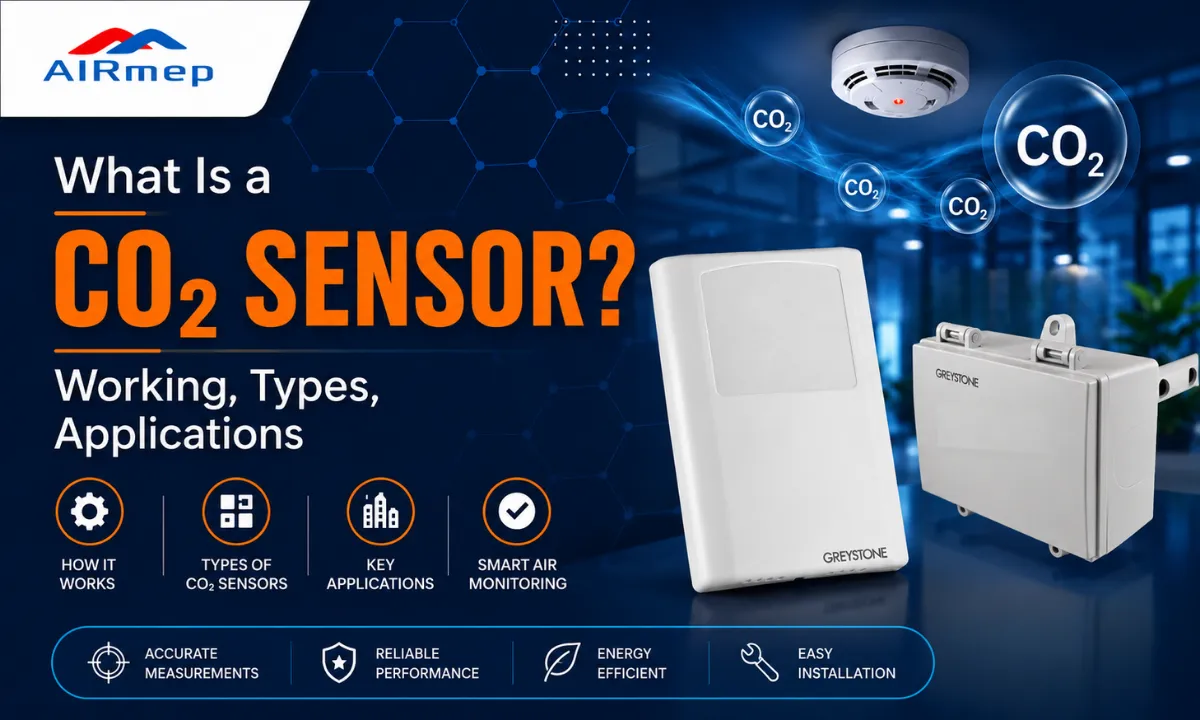
What Is a CO₂ Sensor? Working, Types, Applications

A CO2 sensor is a specialized instrument that measures the levels of carbon dioxide in the surrounding environment. It measures CO2 by identifying its chemical properties in parts per million (ppm). This instrument is widely used to monitor air quality, ensure safety in industrial areas, and increase agricultural output.
Each time you enter an office building or shopping mall, there is a good chance a CO2 sensor is monitoring the air quality you are breathing. Particularly in crowded spaces, where maintaining air quality is highly critical for health, these instruments continuously help improve the air quality. Available in different types, they are used in commercial spaces, schools, hospitals, and other places. So, whether you are buying a CO2 sensor Greystone product systems for home use or industrial use, once you understand its types and how it works, selecting the right one can become much simpler.
Table of Contents
What is a CO2 Sensor?
A CO2 HVAC air quality sensor is an electronic device that measures the concentration of carbon dioxide in the surrounding environment in parts per million (ppm). As carbon dioxide gas is an odorless greenhouse gas, it becomes important to measure it in public spaces like schools, hospitals, and different settings to ensure people’s safety and health.
These sensors work by signaling the advanced ventilation Demand-Controlled Ventilation (DCV) systems to bring fresh air as the CO2 levels increase.
Types of CO2 Sensor
Carbon dioxide sensors are categorized according to their detection mechanism. The primary types include:
1. Non-Dispersive Infrared (NDIR) Sensors
The Non-Dispersive Infrared (NDIR) Sensors detect carbon dioxide levels in the environment. Because CO2 absorbs specific wavelengths of Infrared (IR) light, this HVAC air quality sensor measures how much it is reaching the detector. If less light reaches the detector, it means there are high levels of CO2 present in the air.
Advantages of Non-Dispersive Infrared (NDIR) Sensors:
- High Selectivity
- Long Lifespan and Stability
- No Sensor Poisoning
- Low Maintenance
Downsides of Non-Dispersive Infrared (NDIR) Sensors:
- Higher Initial Cost
- Only Detects IR-active Gases
- Environmental Sensitivity
- Optical Contamination
2. Photoacoustic (PAS) Sensors
Photoacoustic (PAS) Sensors are highly accurate devices that help detect carbon dioxide in the air by converting light into sound. When gas molecules absorb the pulses of light, they make specific sound waves that this sensor carefully listens to and accurately measures the concentration of carbon dioxide.
Advantages of Photoacoustic (PAS) Sensors:
- Ultra-High Sensitivity
- Zero Baseline Drift
- Compact Size
- High Specificity
Downsides of Photoacoustic (PAS) Sensors:
- Susceptibility to Acoustic and Mechanical Noise
- Sensitive to Environmental Factors
- Higher Complexity
- More expensive than Traditional Sensors
3. Electrochemical Sensors
The Electrochemical Sensor is a tiny and highly specialized HVAC air quality sensor made to detect specific chemicals and gases. It detects carbon dioxide in the air by creating a chemical reaction upon contact and then converts it into an electrical signal.
Advantages of Electrochemical Sensors:
- High Sensitivity
- Cost-Effective
- Low Power Requirements
- Linear Output and Accuracy
Downsides of Electrochemical Sensors:
- Limited Lifespan
- Sensitive to Environmental Changes
- Cross-Sensitivity
- Maintenance Requirements
4. Metal Oxide Semiconductor (MOS) Sensors
Metal Oxide Semiconductor (MOS) Sensors are specialized electronic components mainly used for gas detection and as transistor switches. They detect carbon dioxide by measuring changes in the electrical conductivity of a heated metal-oxide layer.
This carbon dioxide sensor is cost-effective, but lacks high selectivity and requires temperatures of around 200°C to 400°C to react.
Advantages of Metal Oxide Semiconductor (MOS) Sensors:
- Low Cost and Small Size
- High Sensitivity
- Fast Response Time
- Long Lifespan
Downsides of Metal Oxide Semiconductor (MOS) Sensors:
- Low Selectivity
- High Power Consumption
- Environmental Interference
- Baseline Drift
5. eCO2 (Estimated CO2) Sensors
The eCO2 (Estimated CO2) Sensor is a highly budget-friendly carbon dioxide sensor. It is frequently used for educational purposes to calculate approximate CO2 levels by measuring Volatile Organic Compounds (VOCs).
Advantages of eCO2 (Estimated CO2) Sensors:
- Highly Affordable
- Compact Size
- Low Power Consumption
- Multipurpose Suitability
Downsides of eCO2 (Estimated CO2) Sensors:
- Prone to False Readings
- Lack of Absolute Accuracy
- Requires Calibration



What are the Applications of a CO2 Sensor?
A CO2 sensor HVAC has various purposes. It can be used to measure indoor air quality in homes and commercial spaces, hospitals, food and beverage, and carbon dioxide in soil for environmental studies.
Below is a table consisting of the applications of a carbon dioxide sensor, its usage, and its benefits:
| Application | CO₂ Sensors Usage | Benefits |
| Indoor Air Quality (HVAC) | Monitor indoor CO₂ levels to control ventilation based on occupancy (Demand-Controlled Ventilation). | Improves air quality and reduces HVAC energy consumption. |
| Agriculture and Greenhouses | Measure CO₂ levels and trigger CO₂ enrichment for crops. | Enhances photosynthesis and increases crop yield. |
| Industrial Safety | Detects high CO₂ concentrations in confined spaces, breweries, laboratories, and manufacturing facilities. | Protects workers from CO₂ exposure and oxygen-deficient environments. |
| Food & Beverage | Monitor CO₂ levels during modified atmosphere packaging (MAP) and food storage. | Extends shelf life and maintains product quality. |
| Medical and Life Sciences | Control CO₂ levels in incubators and monitor exhaled CO₂ in medical equipment. | Ensures accurate research conditions and supports patient monitoring. |
| Transportation | Monitor cabin air quality and refrigerated transport environments. | Improves passenger comfort and protects temperature-sensitive cargo. |
| Environmental Research | Measure atmospheric and soil CO₂ levels for environmental studies. | Supports climate research and ecosystem monitoring. |
Conclusion
A carbon dioxide sensor is a special instrument that helps detect and measure CO2 levels in the environment. When the levels of carbon dioxide increase in the environment, it signals the Demand-Controlled Ventilation (DCV) systems to regulate the air quality, making it healthy to breathe. Available in different types, these sensors are highly sensitive and provide accurate carbon dioxide concentration detection, which is essential for modern ventilation systems.
Airmep Sales Corp. provides high-quality CO2 sensors for commercial and industrial facilities in India. Our reliable HVAC solutions help you improve indoor air quality, ventilation, and energy efficiency. With this, we also provide required technical support and timely delivery, ensuring a smooth client experience. Therefore, contact us to get the best solutions for carbon dioxide sensors.
Also Read:
- What Is a Carbon Monoxide (CO) Sensor? Working, Types & Applications
- Fire Sprinkler Systems Explained: Wet, Dry, Pre-Action and Deluge Types, Working & Applications
Frequently Asked Questions:
What is a CO₂ sensor?
A carbon dioxide sensor is an instrument that measures the concentration of CO2 levels in the environment in parts per million (ppm).
Which type of CO₂ sensor is the most accurate?
A Non-Dispersive Infrared (NDIR) sensor is considered the most accurate carbon dioxide sensor.
Where are CO₂ sensors commonly used?
The common applications of the carbon dioxide sensors include:
– Commercial and Residential Buildings
– Industrial Facilities
– Hospitals and Laboratories
– Agriculture
– Indoor Air Quality Monitors
Why do we need CO₂ sensors?
We need carbon dioxide sensors to monitor air quality, improve ventilation, and reduce virus transmission.
Can CO₂ sensors improve indoor air quality?
Yes, carbon dioxide sensors can improve air quality by acting as a trigger for the ventilation systems.