info@airmep.in | +91-9810220896 | New Delhi, Delhi, 110015

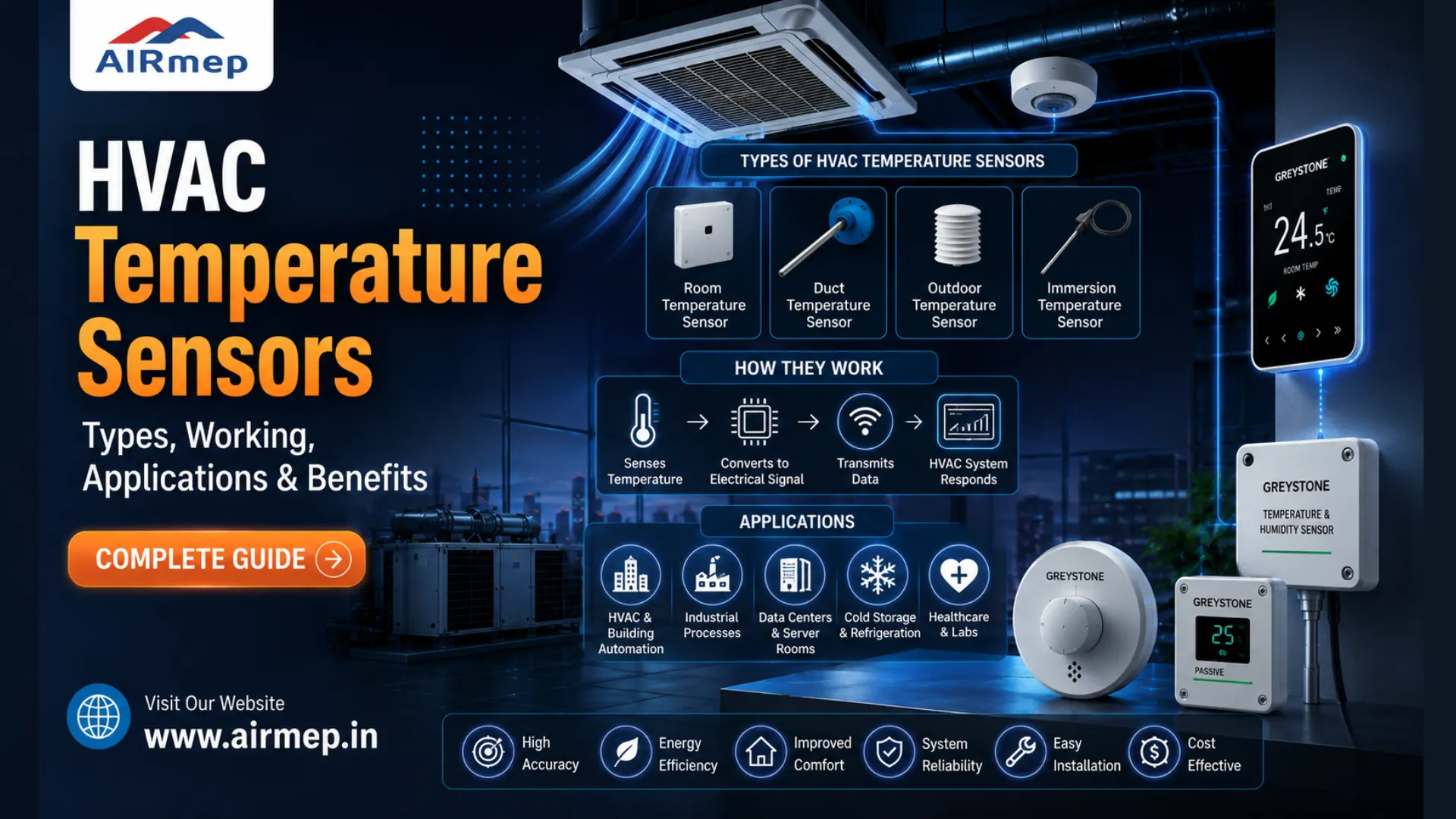
HVAC Temperature Sensors – Types, Working, Applications & Benefits

HVAC temperature sensors supervise and transmit thermal data to building climate control systems. They convert thermal energy into electrical signals, permitting systems to automatically adjust heating, cooling, and ventilation for optimal comfort, energy effectiveness, and indoor air quality.
Cutting-edge buildings demand refined climate control to keep occupants comfortable and tools operating securely. At the center of every heating, air conditioning, and ventilation system is a hidden network of modern elements working constantly behind the scenes. Among the most crucial of these elements are HVAC temperature sensors.
Whether it is an office building in a primary city or a single-family house, these small gadgets work as the eyes and ears of climate control networks. Without complete temperature monitoring in HVAC systems, tools would operate blindly. This would result in huge energy waste, freezing coils, uncomfortable rooms, and premature system failures.
Table of Contents
What are HVAC Temperature Sensors?
To put it simply, HVAC temperature sensors are electronic gadgets engineered to measure the thermal conditions of water, air, steam, or refrigerant lines within a climate control network. They convert these physical temperature readings into different electrical signals, like variable resistance, voltage, or technical data packets.
These signals are connected directly to a centralized thermostat or a broad building automation system controller. The controller examines the incoming data and immediately determines whether to activate the heating, ramp up the cooling, adjust the fresh air dampers, or change fan speeds to hit a desired indoor climate target.
How HVAC Temperature Sensors Work
Comprehending how HVAC temperature sensors work demands a fast look at the common electrical principles of thermal physics. While various sensor designs use different physical materials, they all follow a simple core loop –
1. Sense – Sensor finds ambient thermal modification in medium.
2. Convert – Modifications move the electrical properties.
3. Transmit – Signal flows over wires to the central controller.
4. Act – Controller adjusts valves, compressors, or blowers.
Most conventional temperature sensors in HVAC systems operate by varying their internal electrical resistance as the atmospheric temperature changes. For instance, in a common negative temperature coefficient thermistor, increasing the ambient temperature results in increased mobility of the electrons within the sensor and a decrease in the overall electrical resistance.
The primary HVAC controllers pass a tiny electrical current through the sensor and measure this fluctuating resistance. The controller compares the resistance value to a pre-programmed scaling chart and determines the precise temperature to within a fraction of a degree.
Types of Temperature Sensors Used in HVAC
There is no single one-size-fits-all sensor for climate control. Various locations of an industrial cooler, boiler, or air duct experience hugely distinct physical demands. Engineers choose different HVAC temperature sensor types based on the necessary precision, temperature limits, and climate conditions.
1. Thermistors
A thermistor is an extremely sensitive, cost-effective semiconductor resistor whose resistance varies substantially with small changes in temperature.
- NTC (Negative Temperature Coefficient) – A thermistor’s resistance decreases as its temperature increases. NTC thermistors are the preferred temperature control devices for residential thermostatic controls, indoors, and for conventional central air conditioners – the NTC thermistor is by far the most frequently used temperature sensor in HVAC systems.
- PTC (Positive Temperature Coefficient) – A thermistor’s resistance increases as its temperature increases. PTC thermistors are rarely used as ambient air temperature sensors, but they are routinely used as safety limit sensors and electrical overload sensors.
2. Resistance Temperature Detectors (RTDs)
RTDs consist of pure metallic wire (usually platinum, nickel, or copper) wrapped around fine coils. Platinum RTDs (such as the industry-standard Pt100 and Pt1000 series) are exemplary in terms of their linear characteristics, long-term stability, and the linear increase in resistance due to heating. Consequently, platinum RTDs are the preferred temperature sensors in industrial HVAC control applications, as well as in complex commercial HVAC temperature sensors where accuracy is essential.
3. Thermocouples
A thermocouple is made up of two different kinds of metal wire that are connected together at one end to create a junction where they can measure temperature. If the junction is subject to temperature change, the thermocouple will generate an extremely low amount of voltage due to the Seebeck effect. The ability to withstand harsh temperature conditions and the durability of thermocouples make them ideal for use in high-heat areas of HVAC systems, such as gas combustion chambers and large industrial boiler flue pipes.
4. Digital Temperature Sensors
Unlike traditional analog temperature sensors, which measure raw electrical resistance, digital temperature sensors for HVAC use an integrated circuit microprocessor to convert the analog temperature reading directly into digital data packets (for example, Modbus or 1-wire protocol) right inside the sensor body.
Because digital temperature sensors don’t need to transmit their reading through long wire runs that may suffer from electrical noise or other types of interference, digital temperature sensors eliminate the risk of data loss or other issues caused by long wire lengths found in many commercial buildings.
Where to Use Temperature Sensors in HVAC?
To sustain balanced climate conditions in a facility, sensors should be strategically placed in a number of different operational areas. Let us find out where are temperature sensors used in HVAC systems –
1. HVAC Duct Temperature Sensors – These probes get mounted inside supply, return, and mixed air ductwork. HVAC duct temperature sensors basically measure the temperature of the conditioned air as it leaves the cooling coils versus the stale air that’s coming back from the building. That way, the system can confirm if its heat exchangers are running at their best, or close enough, and not just kind of guessing.
2. HVAC Room Temperature Sensors – Usually built into wall-mounted thermostats or zone modules, HVAC room temperature sensors watch the real comfort level where people sit and work, not some theoretical number. They help keep the rooms from turning into localized hot spots or cold pockets, and in the end, it’s more stable.
3. HVAC Air Temperature Sensors – This group includes HVAC air temperature sensors placed outdoors on the shaded exterior walls of buildings. By watching the outside ambient conditions, the central system can anticipate stronger heat loads or start energy-saving “economizer cycles”, where cool outside air gets drawn in to help naturally temper the property without relying so much on energy-hungry chillers.
4. Immersion and Surface-Mount Sensors – Immersion sensors are placed inside protective metal tubes, often called thermowells, and put directly into fluid pipelines. They track chilled water loops, hot water boilers, and also liquid refrigerant lines. Surface-mount versions are strapped onto the outside of copper pipes, monitoring the fluid line temperatures without drilling any holes or opening up the system.
Comparison Matrix of HVAC Temperature Sensors
| Sensor Type | Core Principle | Primary Advantage | Best HVAC Application |
| NTC Thermistor | Non-linear resistance drop | High sensitivity, low cost | Residential thermostats & standard HVAC air temperature sensors |
| Platinum RTD (Pt100/Pt1000) | Temperature-induced voltage | Survival in extreme heat ranges | Furnace flame monitoring, industrial boilers |
| Thermocouple | Temperature-induced voltage | Survival in extreme heat ranges | Furnace flame monitoring, industrial boilers |
| Digital Sensor | Microchip data translation | Immune to electrical noise over long distances | Smart HVAC temperature sensors in large automation networks |
Advantages of HVAC Temperature Sensors
Making an investment in top-quality, cutting-edge sensors delivers clear functional benefits for facility managers and homeowners alike. The primary benefits of HVAC temperature sensors comprise –
1. Exceptional Energy Efficiency – By delivering real-time data, sensors control the system from over-cooling or over-heating areas, keeping utility bills low.
2. Extended Equipment Lifespan – Precise data controls short-cycling, decreasing physical wear and tear on compressors and fan motors.
3. Enhanced Occupant Comfort – Tight temperature control sustains stable indoor spaces, removing drafts and stuffiness to boost efficiency.
4. Proactive System Protection – High-limit thermal sensors immediately shut down heating components or boilers if temperatures breach secure thresholds, controlling fires or cracked equipment.
Importance of Temperature Sensors in HVAC Systems
The overarching importance of temperature sensors in HVAC systems lies in their duty as the base of advanced automation. Without precise data collection, even the most modern, multi-million-dollar variable-speed cooler plant is useless. Trusted sensors make sure that every element from automated air valves to water pumps works in ideal harmony to fulfil indoor climate targets.
Improve Energy Efficiency –
Property developers often ask how HVAC sensors improve energy efficiency. When traditional legacy HVAC systems were the norm, they ran on timed schedules or basic on/off cycles and always at 100% operating capacity, regardless of what was actually needed for the inside of the building.
However, by utilising modern smart HVAC temperature sensors that allow for “demand-controlled” operation, a building controller can run predictive cooling models much more effectively by pairing an exterior sensor with multiple interior room sensors. For example, once the exterior temperature drops in the evening, the controller can reduce the capacity of the power-hungry chiller (or compressor) for that building, allowing for use of natural ventilation through open dampers to help save 20-30% of the total amount of energy consumed by the building.
Conclusion
HVAC temperature sensors may be small, but they make a big impact on modern infrastructure. From protecting expensive industrial compressors to reducing monthly power costs with automated climate control, these components are key to effective building management. Choosing the right sensor type and placement and maintaining it regularly will help you get the most out of your heating and cooling for years to come. Looking for reliable HVAC temperature sensors and automation solutions? Contact Airmep Sales Corporation today for expert HVAC solutions tailored to your commercial and industrial requirements.
Also Read: Top 5 Greystone Products Suppliers in India (2026 Guide)
FAQs
How do you tell if an HVAC temperature sensor is faulty?
You usually notice that the system is blowing the wrong temperature air, or it starts short-cycling a lot, like turning on, off, then on again too fast. Sometimes you also see sharp swings between rooms, or the thermostat “feels” unstable. To be sure, test the sensor using a multimeter; check whether its electrical resistance matches the manufacturer’s reference table. If it doesn’t, then it has wandered out of calibration, and yeah, that often means the sensor is the culprit.
Where should indoor HVAC room temperature sensors be installed?
Mount them on an interior wall, around 1.5 meters (5 feet) above the floor, in an area with natural air movement. Don’t put them in direct sunlight, or right by windows that draft a lot, or near hidden hot-water pipes, and definitely don’t install them just under supply vents. Those spots cause temperature bias, which creates false readings and weird control behavior.
What is the difference between an NTC thermistor and a Platinum RTD?
An NTC thermistor is basically a sensitive, inexpensive semiconductor; its resistance drops fast when the temperature goes up, so it works well in everyday thermostats. A Platinum RTD (for example, a Pt100) uses pure metal wire; the resistance changes in a very steady, almost straight-line way. It costs more, but it gives the high repeatability people want in commercial setups, like control loops in plant environments.
How do temperature sensors directly lower a building’s electricity bill?
They help the system leave rigid schedules behind and move toward demand-driven operation. The sensors keep comparing indoor and outdoor conditions, then they instruct the equipment to reduce load, so power-hungry compressors don’t run full blast when the weather is mild.
Why are digital temperature sensors preferred over analog sensors for long cable distances?
A raw electrical signal sent by analog sensors is susceptible to interference from nearby motors or voltage drops over long wire runs. Microchips on digital sensors allow data packets to be converted into temperatures right at the point of measurement, so the signal can travel hundreds of feet without data loss or distortion.