info@airmep.in | +91-9810220896 | New Delhi, Delhi, 110015

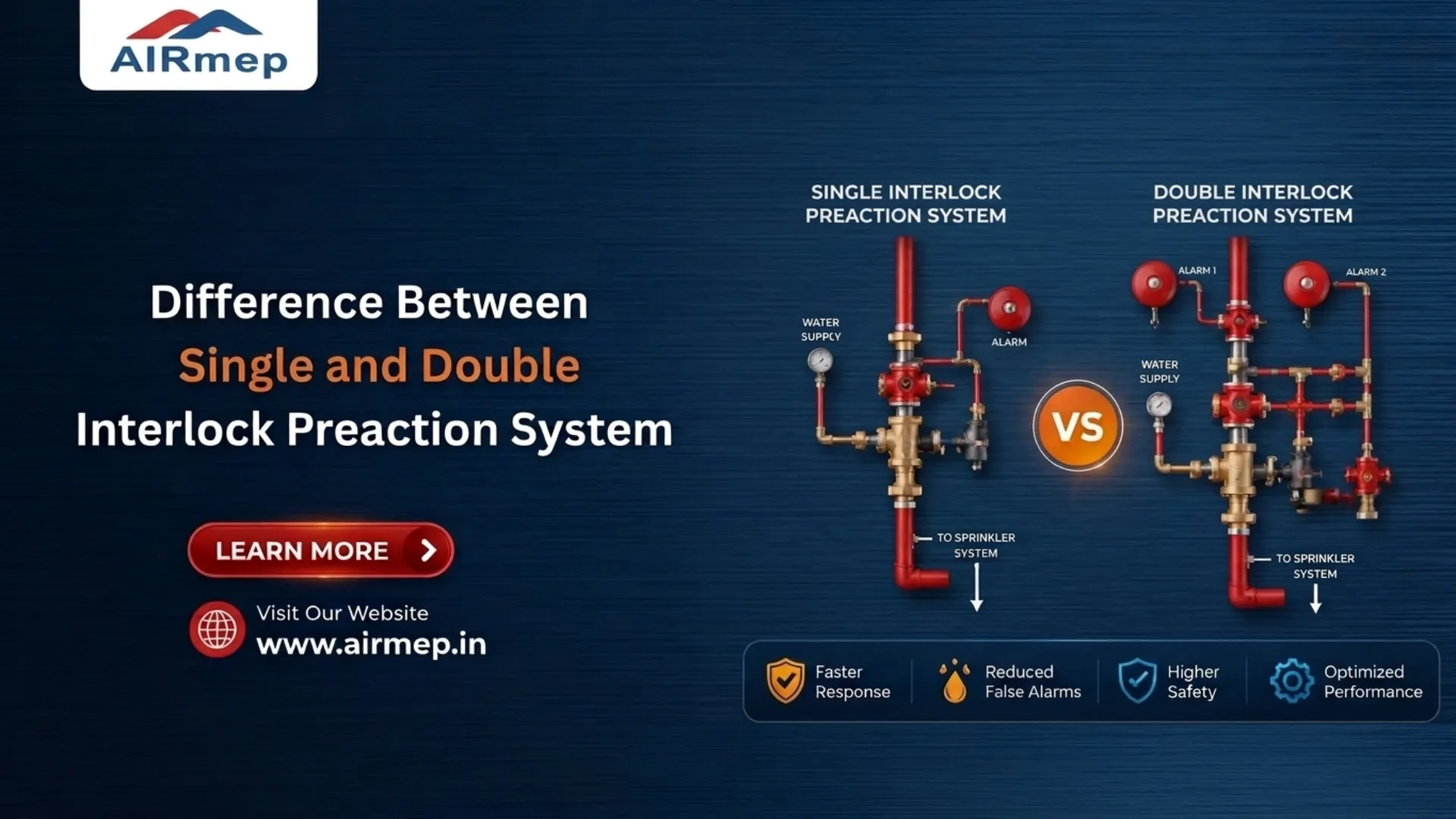
What is the Difference Between a Single and Double Interlock Preaction System?

The main difference between single and double interlock preaction systems is the number of cases needed to release water into the piping. A single interlock system unlocks the valve upon detection of heat or smoke, while a double interlock system demands both detection activation and a sprinkler head to break, delivering excellent security against accidental discharge.
High-value assets (data centers, museums, and libraries) may be protected with standard fire sprinkler systems, but there is some risk associated with using them because they are commonly viewed as a risk to equipment and property in the event of an accident, i.e., a broken pipe. It is here that preaction fire protection systems come into play. If you are exploring fire protection in areas that may be vulnerable to accidents involving water, chances are you have heard of the single and double interlock preaction system. The question is which type is best suited for your needs?
Table of Contents
What is a Preaction Sprinkler System?
Before making a comparison between these two, let’s comprehend how a preaction system works. Unlike a standard sprinkler system, where the pipes are consistently full of water (wet pipe), a preaction system keeps the water back behind a “preaction valve.” The pipes are filled with air or nitrogen rather than.
Water only enters the pipes when specific “events” occur. This works as a security net against accidental leaks. Organizations like Airmep Sales Corporation have expertise in these systems to make sure that water is only released when there is a verified fire.
Single Interlock Preaction System
The purpose of a single interlock preaction system is to offer fire protection to locations where accidental discharge of water from pipes should be avoided, yet provide a rapid response to fire.
Operation of a Single Interlock Preaction System.
To activate the water to the piping system under this system, one primary event must happen; an event that typically represents the initial detection of a fire, such as activation of a fire detection device (e.g., smoke detector/heat detector, etc.).
Below are the sequences of operation for this system –
Step 1 – The smoke detector detects heat or smoke from a fire.
Step 2 – The smoke detector sends a signal to the preaction/delay valve.
Step 3 – Preaction/delay valve opens.
Step 4 – Water flows into the piping system and remains in the piping system until heat from the fire activates a sprinkler head (melting of the solder joint ) and the water is discharged.
Best Use Case –
Preaction systems (single interlock) are widely used in museums, libraries, and galleries to protect them from accidental discharge caused by construction personnel or others damaging the piping system with no water flow in the piping system. However, when a fire is detected, the system becomes “primed” to instantly release water.
Double Interlock Preaction System
A double interlock preaction system is inherently more conservative than all other types of systems because it requires two separate events to occur simultaneously before allowing any water into the pipe(s).
How it Works –
Water will not flow unless both (1) the fire detection system and (2) the sprinkler head have been activated.
- EVENT A – Smoke or heat detected by the smoke or heat detector (fire).
- EVENT B – The sprinkler head melts, thereby releasing the pressurized air within the pipe(s), allowing water to flow into the pipe(s).
- The Result – Therefore, the pre-action valve will only open when both Event A and Event B have occurred.
Best Use Case –
This is the recommended system for use in data centers, server rooms, and stores containing cold warehousing. In these types of environments, the financial consequences of accidental water damage are so significant that this system provides “double validation” that there is a fire before allowing water to flow.
Single vs Double Interlock Preaction – The Main Differences
| Feature | Single Interlock | Double Interlock |
| Activation Requirement | One event (Detection system) | Two events (Detection + Sprinkler head) |
| Water in Pipes | Fills as soon as smoke is detected | Only fills if a fire is fully confirmed |
| Response Speed | Faster (Water is already in pipes) | Slower (Pipes must fill after fire is confirmed) |
| Risk of Accidental Leak | Low | Very Low (Extremely rare) |
| Complexity | Simpler to install and maintain | More complex and expensive |
Why Choose Airmep Sales Corporation?
It takes technical skills to pick the correct system. A trusted name in fire safety products, Airmep Sales Corporation can help you choose between various preaction sprinkler systems. Airmep provides quality system parts, such as valves, piping, and detectors, specifically designed for your building’s requirements.
Whether you need to choose between the fast response of single interlocks or maximum prevention provided by double interlocks, Airmep will install your selected system in compliance with International Safety Codes (ISCs).



How to Decide Which System is Right for You?
To determine if you need a single vs double interlock preaction system, consider these three questions.
1. Is your equipment sensitive? If you have millions of dollars’ worth of servers in a data center, you should use a double interlocked system. If you only have sensitive items located in a room that is typically occupied (like a library), a single interlocked system will generally work.
2. How quickly will fire spread? The single interlocked systems have water already in the piping before heat activates the sprinkler head; so, the single interlocked system is the quickest way to provide fire protection. In a high-hazard area, speed may be more important than an additional layer of safety.
3. What is your budget? Installing and maintaining double interlocked systems more expensive than single interlocked systems? They will require additional equipment (air compressor and control panel). Thus, there would be a higher installation and ongoing maintenance cost for double interlocked compared to single interlocked systems.
Maintenance and Safety Tips
Proper maintenance is essential for all types of systems, regardless of your choice of piping systems. Due to the fact that the interior of the pipe will usually be dry until it is filled with water, any moisture present (e.g., from condensation) could create conditions leading to corrosion within the pipe.
1. Fill Pipes With Nitrogen – Instead of filling your pipe with air, try using nitrogen instead. This will help eliminate rust and extend the useful life of your system.
2. Perform Annual Testing – Make sure that a qualified technician from Airmep Sales Corporation or a similar company checks your preaction valve at least once a year to confirm that it will function properly in the event of an emergency.
Conclusion
The difference between preaction systems is based on the amount of proof required before allowing water into the building. A single-interlock preaction system relies only on a smoke detector, while a double-interlock preaction system requires activation of both a smoke detector and a sprinkler head that has melted due to a fire.
Knowing these differences allows you to reduce the possibility of a fire destroying your property while at the same time reducing the chance of suffering excessive and costly water damage as a result of being watered by a sprinkler that has been activated unnecessarily.
Also Read: What Is a Fire Pipe Coupling? Types, Uses & Benefits