info@airmep.in | +91-9810220896 | New Delhi, Delhi, 110015

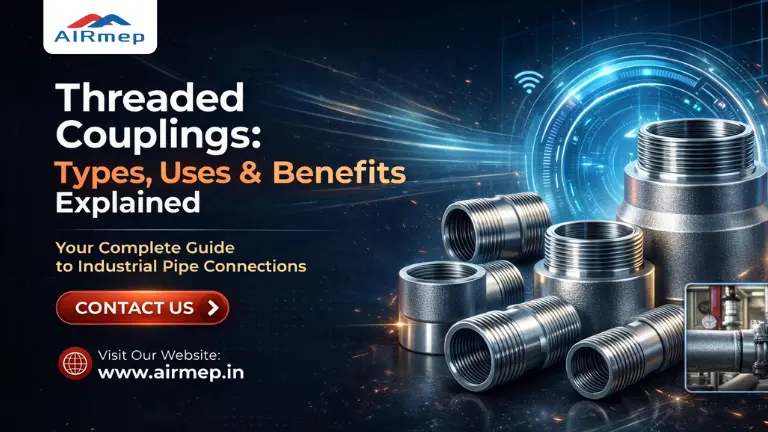
What Are Threaded Couplings? Types, Uses & Benefits Explained

Threaded couplings are short, hollow pipe fittings with internal threads that are made to connect two male-threaded pipes or parts in a straight line. They are used a lot in systems with low to medium pressure because they make connections that are safe and won’t leak, and they can be put together and taken apart without welding.
Threaded coupling is an essential threaded pipe fitting in the world of construction, industrial piping, and plumbing. Simply put, the threaded couplings is the one threaded pipe fitting component you can’t live without when connecting pipes in a timely and secure manner.
If you are constructing a new home or becoming the manager of an industrial chemical plant, knowing how to use a threaded pipe fitting is important. Therefore, in this journey of learning more about threaded pipe fittings, we will be discussing their type, their use, and the benefits of threaded pipe fittings in your piping systems.
Table of Contents
What Are Threaded Couplings?
A threaded coupling is known as a pipe fitting and is typically made from pipe with or without threads. Each end of a coupling has threads that are used to attach two pipes of the same or different sizes together. If you’re looking for ways to connect your two sections of pipe, a “coupling” is a common way to do it.
Visualize a nut connected to two bolts, which allows for a straight connection. Threading enables connection methods that do not require welding or soldering; just screw one end of the pipe into the other, and voila! This also makes threaded pipe fittings popular for jobs where the system has to be disassembled or adjusted.
The Different Threaded Coupling Types
All pipe connections differ from each other. The types of threaded couplings depend on three factors, which include pressure conditions, fluid characteristics, and available installation space. The inventory of leading suppliers, such as Airmep Sales Corporation, includes these three common items.
1. Full Coupling – A full coupling contains threaded ends that extend from both sides of its body. The device connects two pipes that have matching pipe dimensions. This is the most basic and common pipe coupling types used in standard plumbing.
2. Half Coupling – A half coupling contains threads that extend from one end only. The other end is usually prepared for welding (socket weld). These are often used to “tap” into a large pipe or a tank to create a small branch or exit point.
3. Reducing Coupling – Sometimes, you need to connect a large pipe to a smaller one. A reducing coupling (also called a reducer) has two different thread sizes on each end. The piping system operates without any leaks because this system provides an uninterrupted flow between the two segments.
4. Hexagonal Coupling – These fittings function as normal couplings but possess a six-sided hexagonal shape which covers their exterior. This design allows a plumber or technician to use a wrench easily to tighten the connection without slipping.
Common Threaded Pipe Fittings Types
Threaded couplers belong to a broad category of fittings that include many threaded pipe fittings types. While couplers connect two pieces of pipe to each other in alignment, other fittings do things like change the direction of flow or provide a seal for the piping system –
1. Threaded elbows – Change the direction of the pipe by 45 or 90 degrees.
2. Threaded tees – Split an individual pipe into two separate runs (forming a “T” shape).
3. Threaded plugs & caps – Seal the end of a pipe.
4. Threaded unions – Function similarly to couplers; however, they are designed so that the pipes may be easily disconnected without turning the pipes.
Top Threaded Coupling Uses
Threaded couplers are used in nearly all industries. Applications for threaded couplers include –
1. Residential Plumbing – Residential plumbing systems (especially those found in older homes) frequently utilize threaded brass or threaded steel couplers to connect gas (such as for heating) and water plumbing. They can also be installed with basic tools.
2. Oil and Gas Industry – The oil and gas industry takes advantage of the durability of forged steel threaded couplers on piping and in refineries. Heavy-duty threaded couplers can withstand extreme pressure and usually have a coating on them to resist rust in harsh environments.
3. Fire protection – Threaded couplers are also used in fire protection systems (fire sprinkler systems, such as those seen in parking facilities) because the piping in these systems relies on threaded couplers to connect components. Since these systems require periodic inspection and can sometimes require modification or additions to their design, the “screw-together” feature of threaded couplers makes service calls simpler.
4. Chemical Processing – Factories that transport chemicals often methodically utilize threaded couplers made of stainless steel or custom plastic to withstand long-term corrosion, and they create leak-proof seals.
The Major Threaded Coupling Benefits
Engineers and plumbers prefer threaded fittings because they offer better advantages than welding. The first main threaded coupling benefits occurs through its simple installation process.
1. Ease of Installation – A threaded coupling installation requires no specialized equipment because it needs only basic tools. A pipe wrench and some thread sealant (like Teflon tape) are often all you need.
2. Removability and Maintenance – You can remove the threaded coupling to fix a clog or repair damage by simply unscrewing it and then reattaching it after completing the repairs. This method offers significant time and cost savings for repair work.
3. Safety in Volatile Areas – Welding becomes unsafe in areas with flammable gases, such as gas stations and refineries, because welding produces sparks. The application of threaded connections enables “cold” installation, which eliminates fire hazards.
4. High Pressure Resistance – Threaded couplings made from forged steel can withstand extremely high pressure levels. This makes them safer for steam lines and hydraulic systems.
Why Choose Airmep Sales Corporation?



When it comes to purchasing threaded pipe fittings, having good quality is extremely important, as a poor quality fitting, for example, one with a weak thread, can break and cause a significant leak that can result in thousands of dollars worth of damage (financial loss). The Airmep Sales Corp. is one of the best suppliers of high-quality industrial fittings.
When you select a reliable supplier like Airmep, you can be assured that –
- Your fittings will be made to international standards (ASME or ANSI).
- Your materials (e.g., Stainless Steel, Carbon Steel, Alloys) will be authentic & durable.
You will receive expert recommendations regarding which threaded pipe fitting types would be most appropriate for your particular application.
How to Ensure a Leak-Proof Connection
Even the most suitable threaded pipe couplings will leak if not installed precisely. Follow these easy steps –
1. Clean the Threads – Confirm there is no dirt, grease, or metal shavings on the pipe or the coupling.
2. Use Sealant – Apply Teflon tape or pipe dope to the male threads. This fills the small gaps between the metal to control water or gas from escaping.
3. Don’t Over-Tighten – Tighten by hand first, then utilize a wrench for one or two more turns. An overtightened coupling can crack or strip its threads.
Frequently Asked Questions
What is the difference between a full coupling and a half coupling?
A complete coupling is threaded on both ends to attach two separate pipes, while a half coupling is threaded on only one end, with the other end typically welded directly onto a tank or a bigger pipe.
Can threaded couplings be reused?
Yes. One of the primary threaded coupling benefits is that they can be unscrewed for supervision or system modifications and then reinstalled, provided the threads are clean and unbroken.
Do I need to use sealant with threaded pipe fittings?
Yes. To confirm a leak-proof seal, you should always utilize Teflon tape or a pipe thread compound (pipe dope) to fill the microscopic gaps between the male and female threads.
What materials are threaded pipe couplings usually made of?
Typical materials include stainless steel, carbon steel, brass, and PVC. High-pressure industrial systems generally use forged steel fittings from reliable suppliers like Airmep Sales Corporation.
Are threaded couplings suitable for high-pressure systems?
Yes, particularly those developed as “High-Pressure Forged Fittings.” These are engineered to manage the extreme stress found in hydraulic lines, steam systems, and industrial chemical processing.
Conclusion
Threaded couplings are easy to use, work well, and are necessary parts of any piping system. There are many threaded coupling types, from the standard full coupling to specialized reducers, so you can find a solution for any plumbing problem.
You can make better choices for your project if you know the benefits of threaded couplings, like how easy they are to fix and how safe they are. Always buy your parts from trusted professionals like Airmep Sales Corporation to make sure your infrastructure is safe and will last a long time.
Also Read: Top 10 Fire Protection Companies in India (2026 Updated List)